Saturday, February 12, 2022

Biblical Trees


There are many plants mentioned in the Bible. Among those plants are trees. A professor of Tree Biology says that there are 36 trees in the Bible. There are cedars, pines and sycamores. There are trees that grow nuts, dates, figs, applies, olives and bay leaves, the secret ingredient when cooking spaghetti sauce.

In Psalm 1, which we read today, we hear that the person who follows God’s law is like a tree planted by streams of water that yields its fruit in its season, and its leaf does not wither. Have you ever thought of yourself as a tree? If you could be a tree, what kind would you choose?

There are many trees on my property: crab apples, locusts, pines, birches and oaks. I don’t think I would be any of those. I would like to be a Giant Redwood. I would be so big that you could drive a car through my trunk!

The Bible says that Wisdom is a tree of life to those who embrace her and hold her tightly (Proverbs 3:18). After the flood, a bird brought Noah the branch of an olive tree. Zacchaeus could not see Jesus as he passed through his town so he climbed a sycamore tree. Once when he could not find fruit on it, Jesus cursed a fig tree and it died. Jesus himself died on a tree. From that tree, Jesus gives us eternal life. So, trees are important to us and to God.

A poet once wrote that a tree looks at God all day, and lifts her leafy arms to pray. He ended his poem with these words, “Poems are made by fools like me, but only God can make a tree.” Only God can make a tree, and only God can make you and me. Trees are important to God, but you are even more important.

With that, let us pray. Heavenly Father, from whom all fatherhood in heaven and earth is named, bless these and all children. Give their fathers and mothers the spirit of wisdom and love, so that the homes in which they grow up may be to them an image of Your Kingdom, and the care of their parents a likeness of Your love. We pray in the Name of the Father and the Son and the Holy Spirit. Amen.

Thursday, February 10, 2022

People, Passage, Practical Application


God’s grace, peace and mercy be with you. … My sermon title is People, Passage and Practical Application, and my focus is our Gospel (Luke 6:17-26). Let us pray. Heavenly Father, the psalmist wrote, “I rejoiced when they said to me, ‘Let us go to the house of the Lord.’” Now that our feet are within your gates, we rejoice to hear your Word. As we listen, may your Spirit enlighten our minds and move our hearts to love deeply as Jesus loved. This we pray to you, Most Holy Trinity. Amen.

People, people who need people are the luckiest people in the world. People, written by Jule Styne and Bob Merrill for the 1964 Broadway musical Funny Girl, is one of the top tunes in American cinema. Funny Girl is based on the life and career of Broadway and film star and comedian Fanny Brice and her stormy relationship with entrepreneur and gambler Nicky Arnstein.

Styne and Merrill were hired to write the musical score and met each other for the first time in 1962 in Palm Beach, Florida. They wrote their songs by day and tested them by night on the Palm Beach socialites at cocktail parties. They wrote People in thirty minutes.

Twenty years before Styne and Merrill penned their lyrics, American Psychologist Abraham Maslow published his hierarchy of needs, a theory of psychological health predicated on fulfilling innate human needs in priority. Maslow stressed the importance of focusing on the positive qualities in people. From the most basic, he listed five levels of needs: physiological, safety, love and belonging, esteem and self-actualization. In other words, people have needs.

Jesus knew people had needs long before Maslow. For a considerable time, Jesus has been carrying out the program he announced in Nazareth. In chapter four we read, “The Spirit of the Lord is upon me, because he has anointed me to proclaim good news to the poor. He has sent me to proclaim liberty to captives and recovery of sight to the blind, to free those who are oppressed, and to proclaim a year of the Lord’s favor.”[1] In the context of this ministry, he called people to be his companions and spearhead His Church’s mission.

In a long sermon, which we hear today, He outlined the attitudes and behavior that distinguish people in this new community from others. The narrative implies that Jesus called the apostles up to the mountain where he spent the night in prayer. He then came down with them to stand on a level place. There he was with a great crowd of his disciples and a great multitude of others from Judea, Jerusalem, Tyre and Sidon. They gathered to hear Jesus and to be healed of their diseases.

Everyone was trying to touch him because power came out of him and He healed all of them. There, before Jesus is an array of burdened and afflicted humanity whom he taught at length, and they longed to access his healing and liberating power. What Jesus spoke was like the charge one receives before an ordination or a sermon a pastor delivers to those about to be confirmed: formal instruction regarding who they must be and how they must behave before the wider group that they will serve. Specifically, the Twelve and the disciples serve the crowds of people.

This wider group of people had needs that the Twelve and other disciples would address. Luke did not use Maslow’s words, but members of Luke’s community would address people’s basic needs without forsaking the Gospel, particularly love and belonging. And so, we move from my first point, people, to my second point, passage.

As I said a moment ago, within this setting, Luke presents Jesus imparting a great body of knowledge. His version is shorter than Matthew’s, but Luke reserved a good deal of material for Jesus’ journey to Jerusalem. Both begin with a series of Beatitudes. Luke has four, followed by four corresponding woes. Compare Luke’s “Blessed are you who are poor” to Matthew’s “Blessed are the poor in spirit.” While Matthew massaged his to address his community, Luke’s is blunt and definite.

Strictly speaking, the biblical tradition “blessed” does not indicate a fortunate or advantageous position (in view of what God intends to do to bring about His Kingdom). Blessed really amounted to “Congratulations” – the sort of thing you might say to a friend who won the lottery.

The Beatitudes are highly provocative. This series of oxymorons is outrageous in any age. I mean, why congratulate the poor on being poor or the hungry on being hungry? Why praise the weeping and the scorned? Correspondingly, it appears foolish to declare unfortunate the wealthy, well-fed, the laughing and those with good reputations. These four states are not morally bad; and other things being equal, they are perfectly desirable.

The point is, however, that in the vision of Jesus other things are not equal. The Beatitudes and Woes make sense in light of the coming reversal of fortune prominent in Luke’s view of salvation. Mary proclaimed this reversal in her Magnificat: “He has scattered the proud in their conceit. He has cast down the mighty from their thrones, and has lifted up the lowly. He has filled the hungry with good things, and the rich he has sent away empty.”[2]  In chapter four, Jesus himself announced good news for the poor, sight for the blind, and liberty for captives.

This reversal of fortune makes it better to be poor, hungry, weeping and reviled rather than rich, full, laughing and respected. So imminent and certain is the reversal of one’s state in life that the thought of it overcomes the pain of those listening to Jesus’ words. In the light of expecting the arrival of God’s Kingdom – and only in this light – it becomes reasonable to hold together “blessed” and “poor” and other contradictory pairs. So, Jesus is not endorsing poverty or hunger. He is insisting that what most people calculate to be advantages and disadvantages are relative, and indeed reversed, in view of the coming of God’s Kingdom.

What the Beatitudes basically depict is a situation of extreme vulnerability. According to what the world values it makes little sense to adopt this posture of vulnerability. Yet in light of the coming of God’s Kingdom, it makes very good sense. Everything ultimately rests upon a particular vision of God – a God who has pledged to act on behalf of the poor and marginalized rather than the rich and the well-off. The Beatitudes and the Woes are provocative both for the poor and the rich. But they do not suggest that the poor should be content with their lot and passively accept it. By calling the poor blessed, the Beatitudes maintain that God has adopted the side of the poor and will reverse the situation. The poor can only benefit from the action of God. The rich have much to lose. The great advantage is to have the ability or the lack of dependence on goods to accept that the God of overflowing generosity can fill your life with blessings. The poor are blessed and the rich are not because God is as Jesus proclaims God to be.

Now, in relation to Beatitudes and Woes, it is often asked whether by the “poor” who are blessed Luke means economically poor or spiritually poor. The whole pattern of Luke’s Gospel suggests that the question poses a false alternative. The poor are certainly economically poor, but at the same time, in Jesus’ day, the poor had become a standard self-description for the faithful in Israel who waited hopefully upon the Lord, that is, people like Simeon and Anna. At the heart of their waiting for salvation lies a deep spiritual longing that may have been present in others whose plight is primarily economic. In this perspective, the poor can include the afflicted in general. The poor are all whose emptiness and destitution provide an opportunity to God to be generous in his actions. The poor wait for the God of Salvation to act on their behalf.

Keep in mind the context in which all this is said to the disciples – in front of the afflicted masses who have come to hear Jesus and to be healed of their diseases. In the Beatitudes, Jesus depicts his community as vulnerable, and in their vulnerability, they are blessed. Being vulnerable means that I am open to God’s power. A vulnerable community can become for the afflicted an instrument of God’s hospitality. It is the vulnerable who make the world safe for humanity. Let me repeat that: the vulnerable, those open to God’s power, make the world safe for humanity. So much for the passage, my second point.

My third point is practical. What is the practical application of this passage into my life as a Christian and our life as a community? If you search the web for answers to this question, you will find plenty of advice. I could cite pastors and lay people from every walk of life offering advice on how to live the Beatitudes, and end my sermon with their advice. Instead, I am going to tell you a story.

A while back, my brother and sister-in-law visited my wife, Cindy, and me. We spent a beautiful October day sightseeing Chicago. In Millennium Park we noticed a Buddhist monk approach a street vendor selling hot dogs. We were close enough to witness this exchange.

The Buddhist monk approached the vendor and asked, “Make me one with everything.” The vendor handed the monk a dog with everything and the monk handed him a twenty-dollar bill. The vendor put the bill in his apron. After a minute of waiting for his change, the vendor informed the monk, “Change comes from within.”

Of course, it’s a joke, but there is a kernel of truth in humor: change comes from within. There is a lot of advice on how we can live Luke’s Beatitudes, but let me conclude by returning to my first point. Recall the different groups of people listening to Jesus: The Twelve, disciples and a vast array of humanity with assorted human needs. Where are you in that audience?

Where are you as an individual and where are you as a community? Personally, I would say that I see myself as in the group of disciples. In front of me is Jesus, and around me are needy people: poor, hungry, weeping, hated. Who will address their needs? With the help of God, I will. With the help of God, we will. How? We’ll figure it out as we meet them in their need.

Friends, we have everything necessary to serve others in their need. We have Word and Sacrament. We don’t need more books and better blogs; we have the Word – Scripture and the Word Incarnate. We have the Teaching of Jesus and the Holy Spirit – present in our hearts and minds, in our Baptism, Confession, Forgiveness and Lord’s Supper. All we have to do to help a vast array of humanity is to be vulnerable. Being vulnerable means that I am open to God’s power. A vulnerable person, a vulnerable community can be an instrument of God’s hospitality. The vulnerable make the world safe for vulnerable people seeking the Living God.

When we draw near to Jesus, we know that He will give us everything we need to live the Beatitudes. We will know when it happens because the peace of God that surpasses all understanding, will keep our hearts and minds in Christ Jesus. Amen.


[1] Luke 4:18-19.

[2] Luke 1:51-53.


Friday, February 4, 2022

Isaiah's Three C's


God’s grace, peace and mercy be with you. My sermon is entitled Isaiah’s Three C’s: Confession, Commission and Cost. My focus is our first reading (Isaiah 6:1-13). Let us pray. Heavenly Father, the psalmist wrote, “I rejoiced when they said to me, ‘Let us go to the house of the Lord.’” Now that our feet are within your gates, we rejoice to hear your Word. As we listen, may your Spirit enlighten our minds and move our hearts to love deeply as Jesus loved. This we pray to you, Most Holy Trinity. Amen.

Most merciful God, we confess that we are by nature sinful and unclean. We recite those words every week as we confess our sins. The word confession is an acknowledgment of a fault or wrong. We disclose our sins however slight or great they are, and God – through the Church’s Pastor – grants us absolution or forgiveness in the name of the Father, Son and Holy Spirit.

I mention confession because Isaiah confesses that he is a man of unclean lips, dwelling in the midst of a people of unclean lips. Isaiah’s first six chapters have been written not in chronological order but in order to make a theological point.[1] The point is: if the people of unclean lips can have the same experience as he, the man of unclean lips, how can a corrupt, rebellious, defiant people ever become the promised, clean, obedient Israel from whom all the nations learn God’s teaching?

Read the first five chapters of Isaiah, and you see that Israel was corrupt from head to toe. Its leaders and its people were so addicted to sin that they were worse than the residents of Sodom and Gomorrah. They trampled the courts and celebrated pagan feasts. They exercised injustice and oppression. Murderers, prostitutes, thieves, psychics and the bribed ruled the land. As the threat of invasion loomed, its leaders sought alliances rather than trusting God. In short, these chapters, like the rest of the book, speak of God’s judgment. And yet, intertwined into judgment is hope.

The mentioning of the year that King Uzziah died is significant because it is with this death that Judah’s truly hopeless situation emerged. By this time the Assyrian emperor Tiglath-Pileser III had clearly established himself as a military conqueror to be feared.[2] As long as Uzziah was king, the threat was uncertain, but with his death danger was imminent. His son, Jotham, was no strong king, and Jotham’s son, Ahaz, was considered a puppet of the pro-Assyrian party in Judah.

Keep in mind that Jotham ruled as king for 11 years before his father’s death because the elder had a skin disease and he tended to spend a lot of time in the Temple burning incense. Hence, Jotham reigned as governor of the palace, and his father lived in a separate house as a leper.[3]

Jotham did what was right in the eyes of the Lord, according to all that his father Uzziah had done. Nevertheless, the high places were not removed. The people still sacrificed and made offerings on the high places.[4]

Ahaz ascended to the throne after Jotham’s death, but because his father was weak, the young Ahaz called the shots. While the Kings of Israel and Damascus were desperate for some way of stopping the aggressive Tiglath, who by this time had captured all of Syria except the capital, Damascus, Ahaz aligned himself with the pro-Assyrian party in order to appease Tiglath. The two kings formed an alliance and approached Ahaz who trembled at the thought of Tiglath not only capturing Judah, but also forcibly resettling the Jews elsewhere and other peoples into his kingdom. Forced resettlement was one of Tiglath’s ways of keeping the peace. The other was brutal torture of the captives.

Chapter six serves as a prelude of how Ahaz trusted in the power of the world to deliver him, refusing to submit his plans and ways to God. The result was destruction. Later in the book, we see how King Hezekiah submits himself to God and calls on the people to do likewise. The result was deliverance. Chapters 7-39 contrast the ways of the two kings and depict a God who has the power to care for his servants. In short, Isaiah’s confession spoke of the sins of the king and the people who embraced not the ways of their God, but the ways and gods of other nations.

That brings me to my second point, Commission. The word comes to us from the Latin words commissio or committere meaning to unite, connect, combine or bring together. Its root words are com meaning with or together, and mittere meaning to release, send or throw.

There are a number of definitions for the word commission. As a verb, you can commission a ship or can commission your portrait to be painted or your biography to be written. The military commissions officers. As a noun, you can earn a commission when you sell real estate or vehicles. The commission Isaiah received was an authorization or command to act in a prescribed manner or to perform prescribed acts. It is a charge.

Upon the death of King Uzziah, Isaiah saw the rise and control of the pro-Assyrian party. As he pondered who is the king in this world, it was revealed to him. He exclaimed, “My eyes have seen the King, the Lord of hosts!”[5] What he saw was the Lord sitting upon a throne, high and lifted up; and the train of his robe filled the temple. Let me read that again. The train of his robe filled the temple. It is within the context of this vision, a vision in which he saw not only the immensity of God, but also sensed His holiness, heard His thunderous voice, and smelled the thick smoke filling the temple, that he realized his powerlessness in the face of an all-powerful God. As he realized that he was doomed, and confessed his sinfulness, God removed his guilt and purged his sins.

We read that God did this through an angel who touched Isaiah’s lips with a burning coal. Now, we read elsewhere in the Bible of how fire, coal, smoke, incense and angels were used to cleanse people of their sins and heal them.[6] And I can tell you from personal experience of working at B&W, how hot the touch of that coal is. In the winter, when snow and ice rested on that load of scrap metal lowered into the furnace, if you didn’t take cover, the sparks would not only burn through your clothes but also through your skin. In that case, I was not purged of my sins. I digress.

Although Isaiah confessed that his lips were unclean, it was his way of saying that it was his heart that was unclean. Jesus explained this when he taught, “What comes out of the mouth proceeds from the heart, and this defiles a person. For out of the heart come evil thoughts, murder, adultery, sexual immorality, theft, false witness, slander.”[7]

It was at this point that Isaiah heard the voice of the Lord saying, “Whom shall I send, and who will go for us?” Then [he] said, “Here I am! Send me.” And God said, “Go!”[8]His experience of divine grace cleansed his heart and he wanted to serve this holy Sovereign of the universe.[9] And then, God commanded him to say this: “’Keep on hearing, but do not understand; keep on seeing, but do not perceive.’ Make the heart of this people dull, and their ears heavy, and blind their eyes; lest they see with their eyes, and hear with their ears, and understand with their hearts, and turn and be healed.”[10]

Isaiah’s commissioning makes one wonder if God wanted to save His people or not. Now, suppose Isaiah chose to be among the false prophets who preached affirmation and encouragement that did not address the people’s sin directly. He could have attracted a large following if he only told people to make a place for God in their lives. They could have been “healed” but only temporarily and superficially, with no impact on the nation itself.[11]

Instead, he was commissioned to preach a message that would only push people further from God. Yet, some would heed his words and preserve them until the days of cauterizing fires of the Exile fall and there would finally be a generation willing to listen. Only then would real healing occur, and the stage would be set for the promised Messiah to come.[12] Isaiah’s call was not to success in the eyes of the world, but faithfulness to a difficult commission. I am sure the cost to preach this scorched earth message wrenched Isaiah’s heart and mind.

That brings me to my third point, Cost. The word, cost, comes to us from the Latin word costare, meaning to stand at or with. Costare is formed from com meaning with or together and stare meaning to stand. Most of the time, we use the word cost when we discuss some economic topic, such as the cost of living, food, gas, education and so on. We also use it when we discuss the cost of freedom or success, like the loss of soldiers or time away from family.

In our passage today, there are costs. As I mentioned a moment ago, there is a cost to Isaiah preaching God’s message. Standing with God cost him popularity. Read the oracles of the next 30 chapters. Hear Isaiah’s words as his recipients heard them because when you hear his prophecies of judgment and doom, you will not want to stand with him.

The cost to the Kingdom of Judah was near total destruction. As we read in the final verses of today’s passage, Isaiah was to preach this message “until cities lie waste without inhabitant, and houses without people, and the land is a desolate waste, and the Lord removes people far away, and the forsaken places are many in the midst of the land.”[13] And if you think that’s the end of it, think again. “Though a tenth remain in it, it will be burned again, like a terebinth or an oak, whose stump remains when it is felled.”[14]

            There is no other way. If these people were allowed to continue as they were, there would be no hope. Their religion was half-pagan, and if they were allowed to continue, they would be completely pagan. God would not allow this to happen. After this frighteningly thorough cleansing, one of the burned-out stumps would still have life in it.[15]

            The last words of God’s message are, “The holy seed is its stump.”[16] Biblical scholars debate the meaning of this verse. Some say that the holy seed can mean the people of God, while others think it means the Messiah. The point is that the people’s only hope is in God alone.

The people’s only hope is in God alone. Our only hope is in God alone. When I read and study these passages, I struggle. During prayer, like Isaiah, I realize that I too am a person of unclean lips. Like Peter, I realize that I am a sinful man. And when I look around, I see that I am living among sinful people; people of sinful lips, sinful hearts and minds. And I realize that our only hope is in God alone.

So, what am I to do? I must say that when I read, study and pray over this passage, I struggle not only with my sin, but also with my call to follow Christ and the cost of discipleship. In prayer Isaiah’s vision of God is immense. The train of God’s robe filled the temple. In comparison, Isaiah realizes that that he is a puny, sinful man. Yet, God manifests Himself through this puny, sinful man. And God can show Himself to the world through you and me, and through us as the Body of Christ, as Church.

This past week, I read two items that caused me to reflect on this passage. One is a quote from the 17th century philosopher, Baruch Spinoza, whose naturalistic views on God, the world, the human being and knowledge served to ground a moral philosophy centered on the control of the passions leading to virtue and happiness. He once wrote that we feel we are eternal. Our instincts tell us that we will live forever.[17] Yet, experience tells us that we will not. We all have an expiration date, and are best used before that date.

That said, the other item I read was about the 1% rule.[18] The author points out that of those who make New Year’s resolutions, over 90% do not keep them beyond January 12th. He went on to cite how a new trainer of the Olympic British Cycling Team, which had not won the Tour de France or Olympic Gold in over a century, got them to win 178 World Championships and 66 Olympic and Paralympic gold medals between 2007-2017. He did it by refusing to underestimate the power of small things. In essence, the new trainer made mediocre cyclists into great athletes by aiming to be 1% better every day.

That is what Isaiah spoke to the people later in the book. He said, “It is not enough for you to be my servant, to raise up the tribe of Jacob, and to restore the protected ones of Israel. I will also make you a light for the nations, to bring my salvation to the ends of the earth.”[19]

Indeed, you and I are sinners living in a world of sinners, unbelievers, pagans and scoffers. Confessing our sins, we are redeemed for a divine commission – to bring salvation through Christ Crucified to the ends of the earth. The cost in the world’s terms is great, but it has already been paid by Jesus Christ on the Cross. He is the payor and the price paid for you and me. So, it’s not enough for us to simply gather for worship or tune in via social media. God commissions us to bring His salvation to sinners yet to be saved. As we depart from here, may Jesus’ love and the Holy Spirit increase in us love for the Father’s will each and every day by 1%. When that happens, may the peace of God that surpasses all understanding, keep our hearts and minds in Christ Jesus. Amen.


[1] John N. Oswalt, Isaiah: The NIV Application Commentary: From Biblical text to Contemporary Life. Grand Rapids MI: Zondervan (2003), p. 125.

[2] Oswalt, 126.

[3] https://en.wikipedia.org/wiki/Jotham

[4] 2 Kings 16:5-6.

[5] Isaiah 6:5.

[6] Revelation 8:3; Numbers 16:46; Ezekial 10:2; Matthew 3:11; Leviticus 16:12.

[7] Matthew 15:18-19; see also James 3:9-12.

[8] Isaiah 6:8-9a.

[9] Oswalt, 127.

[10] Isaiah 6:9-10.

[11] Oswalt, 128.

[12] Ibid.

[13] Isaiah 6:11-12.

[14] Isaiah 6:13.

[15] Oswalt, 128.

[16] Isaiah 6:13.

[17] Reginald Garrigou-LaGrange, Thomistic Common Sense: The Philosophy of Being and the Development of Doctrine. Translated by Matthew K. Minerd. Steubenville OH: Emmaus Academic (2021). p. 111.

[18] Mike Schmitz, “Just 1 Percent,” The Word Among Us, February 2022 (Volume 41: Number 3), pp. 4-9.

[19] Isaiah 49:6. (Berean Study Bible)

Thursday, February 3, 2022

How Big is God?


How big is God? When Jesus was born, he was probably six or seven pounds and around 20 inches long. When he was found in the Temple by his parents, he was 12. He probably weighed 100 pounds and was less than five feet tall. As a man, maybe Jesus was 150 pounds and five- and one-half feet tall.

I say all that because in our reading from Isaiah today (6:1-13), God is huge. How huge? Isaiah wrote that the train of his robe filled the temple. Now, when Isaiah used the word train, he did not mean a choo-choo train. He meant the back part of his robe was ten times bigger than our church. (Picture)

The train is the back portion of the robe that hangs down and sweeps across the floor symbolizing majesty and honor. Lots of times, a woman who is getting married will have a train on her wedding dress. The king’s train was made up of pieces of the royal robes of other enemy kings he beat in battles. And when Isaiah looked at the train on God's robe there were so many enemies that God beat that the train of his robe filled the entire temple. So, how big is God? God is huge!

If God is huge, how big is his loving heart? God’s loving heart is so big that he loves all of us all the time. That’s a lot of love.

We have four grandchildren, and I love them all. Sometimes, I don’t like what they say or do, and when we babysit them, I have to correct them, but I don’t stop loving them. Well, could you imagine having 8 billion grandchildren and loving every one of them? That’s how many people there are in the world. And God knows every one of them, and He loves every one of them. Most importantly, God loves you. And that’s huge!

With that, let us pray. Heavenly Father, from whom all fatherhood in heaven and earth is named, bless these and all children. Give their fathers and mothers the spirit of wisdom and love, so that the homes in which they grow up may be to them an image of Your Kingdom, and the care of their parents a likeness of Your love. We pray in the Name of the Father and the Son and the Holy Spirit. Amen.

Saturday, January 29, 2022

God Knows You


How long have you known someone? Last Sunday, I met for the first time the new pastor at Prince of Peace Church. So, I have known him only a week. I have known some of the members here less than two years. I have known my wife twelve years. I have known my older brother ever since I can remember. And I have known my grandchildren before they were born.

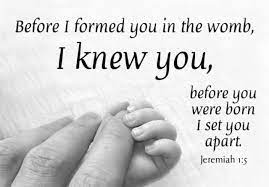
I mention how long I have known people because in our first reading today (Jeremiah 1:4-10), we read that God knew Jeremiah before he was formed in his mother. No matter how long any of us know someone, God has known that person even before he was in his mother.

Not only that, God knew what Jeremiah was to become even before he knew. God knew what I was to do even before I knew it. When I think about this, I feel overwhelmed with awe; and all I can say is, “Wow!”

Now, do you know what you want to be when you become an adult? Some people know when they are children what they want to be. My brother always wanted to be a chemist. He became a chemist. My niece is a nurse, and I am not surprised because her mom is a nurse. Maybe you will become what your mom or dad is, or maybe not. God already knows. That’s why it’s important, even as children, that you ask God to show you what you are to become.

What you become may not be easy. It was not easy for Jeremiah to become a prophet or Jesus to be the Savior. So, start asking God what He wants you to become and ask for the strength to become that. Ask God that as you become what He wants you to be that you can praise him as Jeremiah and Jesus did. With that, let us pray.

Heavenly Father, from whom all fatherhood in heaven and earth is named, bless these and all children. Give their fathers and mothers the spirit of wisdom and love, so that the homes in which they grow up may be to them an image of Your Kingdom, and the care of their parents a likeness of Your love. We pray in the Name of the Father and the Son and the Holy Spirit. Amen.

Thursday, January 27, 2022

Paul's Song, Letter and World


God’s grace, peace and mercy be with you. My sermon is entitled Paul’s Song, Letter and World. My focus is our Epistle (1st Corinthians 12:31b-13:13). Let us pray. Heavenly Father, the psalmist wrote, “I rejoiced when they said to me, ‘Let us go to the house of the Lord.’” Now that our feet are within your gates, we rejoice to hear your Word. As we listen, may your Spirit enlighten our minds and move our hearts to love deeply as Jesus loved. This we pray to you, Most Holy Trinity. Amen.

“Puff the magic dragon lived by the sea and frolicked in the autumn mist in a land called Honali.” I open with these words for two reasons. First, when Cindy and I celebrated five years of marriage, we travelled to Hawaii, and one of the sites we visited was Hanalei on the north shore of the island of Kauai. Fewer than 500 people live in Hanalei, a village smaller than one square mile. Hanalei is often associated with the song popularized by Peter, Paul and Mary.

Second, one member of the trio who sang Puff the Magic Dragon also wrote a song we requested for our wedding. Paul Stookey wrote Wedding Song in 1969 and performed it at the wedding of Peter Yarrow, the other male singer of the trio.

Shortly after his Christian conversion, Yarrow asked Stookey to “bless our wedding with a song.” According to Stookey, “the melody and the words arrived simultaneously and in response to a direct prayer asking God how the divine could be present at Peter’s wedding.” Drawing almost verbatim from Matthew 18:20, the original lyric is “I am now to be among you at the calling of your hearts; rest assured this troubadour is acting on My part. The union of your spirits here has caused Me to remain for whenever two or more of you are gathered in My name, There am I...There is Love.”

Concerned that the wedding guests might misinterpret his intention, Stookey changed “I” to “He” until 1990 when he ‘officially’ restored the original lyric.

The first two lines of the second verse, “A man shall leave his mother and a woman leave her home. And they shall travel on to where the two shall be as one,” paraphrased Genesis 2:24: "Therefore a man shall leave his father and mother and be joined to his wife, and they shall become one flesh."

Believing he could not take personal credit for composing "The Wedding Song", Stookey set up the Public Domain Foundation, which since 1971 received the song's royalties for charitable distribution. … If you have time this week, listen to Paul’s song. You will enjoy it.

Couples request many songs and readings for their weddings. Paul’s Letter to the Corinthians is one of the most popular. As a pastor preparing to write a sermon for their wedding, I ask couples why they choose their readings. Often, they reply, “Because we like them.” If couples knew the background of Paul’s Letter, they might choose another passage.

Corinth’s Christians were a mix of Jews and Gentiles from various economic strata. That the rich were shameless and the poor were wretched led to ethical and liturgical problems.

Although not the founding pastor of their church, Paul made several trips to Corinth. In essence, he fathered the community and took great interest in its well-being. The experience of Paul’s second trip, however, left him heart-broken.

Sexual immorality, legal disputes, Eucharistic abuses and controversies about the resurrection of the dead were some of the problems Paul encountered. Yet, the real problem was two-fold: Gnosticism and behavior. The Gnostics were people who thought that they were wiser than everyone. The others thought they could do whatever they wanted.

Chapter 13 concerned itself with behavior that caused serious dissension within the community. While the people causing this dissension were spirit-people or charismatics, Paul addressed the entire church. Paul based his ecclesiology, his teaching of Church, on his Christology, his teaching of Christ. To be Church, Christians were to imitate Christ in their relations with one another. They could not see themselves as wiser nor could they do whatever they wanted.

In chapter 13, Paul pointed out how the Corinthian Christians did not reflect Christ’s love. In verses 4-8, Paul listed what love is and is not. It is not about personal preference. C.S. Lewis said that to love and to like are not the same. I can like some people more than others, but I am to love all people.

To illustrate that love, Paul used the term agape, one of three Greek words for love. Eros is passionate love that desires the other for itself. Philos is love of the gods or good friends. Agape has neither the magic of eros nor the warmth of philos, but is an unmotivated, active love.

Paul understood the differences among the three types of love. After all, he grew up as a typical Hellenistic Jewish student, and as a Christian, understood Jesus’ teaching of love of God, neighbor and enemy. We find all of this in chapter 13, but rather than define love, Paul personified it. He chose verbs that involved another person in order to highlight the virtues that the Corinthians neglected. They were not patient and kind. Some insisted on their own way. The community rejoiced at wrongdoing.

Citing himself as an example, Paul spelled out the characteristics of love in such a way that the Corinthians could recognize it for what it was – the foundation of the Church. In a community where jealousy and rivalry ruled their hearts, hearing that love is not jealous, pompous, inflated, rude, self-seeking, quick-tempered, calculating or joyful in lawlessness or wrongdoing was imperative.

For Paul, love was not a gift from God like other virtues. Love was not a legal command to be fulfilled. The love of which Paul wrote was beyond compare because it was the Spirit of God at work in the Church. As he wrote in chapter one, the Corinthians lacked no skills, but skills without love matter not in a faith community awaiting salvation from their Lord.

At the time Paul visited Corinth, there were about 50 Christians. Gathering 50 adults into one house church would have been difficult, awkward and uncommon. More likely, families, servants and a few friends met in smaller groups fostering an intimate family atmosphere that tended to promote divisions within the wider community.

When these smaller groups came together, divisions were played out. The host group sat in the innermost rooms, while the visitors gathered on the porch. The host group gathered for an early meal, while hungry visitors arrived later. Such liturgical abuses fostered resentment among church members.

While the love of the Trinity should have bonded and energized the Body of Christ, the Church, family ties and friendships tore it apart. That said, why do couples choose Paul’s Letter? That leads me from Paul’s Letter to Paul’s world.

By Paul’s world, I mean, my world, your world. Your world and mine share a common denominator. Each is populated by people. A vast array of people we know and love, know and do not love, and do not know or love populates our worlds. The population is so vast that we cannot consider everyone in a short sermon or a lengthy dissertation; however, we can draw a sampling. Allow me to relate one group of people to our reading: friends and family.

Starry-eyed lovers preparing for marriage relate well to Paul’s song and Paul’s letter as their wedding day approaches. Newlyweds love one another, as they should. The world of newlyweds often consists of one other person – the person they love. In love with one another, they – like we – learn that love for one another may not last, may not suffice. For that reason, couples and families must also love the Other (with a capital O).

The Other – God – gets along perfectly well without us. Can we get along without God? Some argue that we can. They say we can get along without God when our needs are met. They have money and all that it can buy. They have a strong body and healthy mind. They are independent and self-reliant, and have someone to love, and family and friends.

However, what happens when friends get busy or distracted? When family members move away, get sick or die? What happens when loved ones contract cancer or Alzheimer’s? When they lose their job or health? Can they get along without God at those moments? Personally speaking, when my dad died suddenly and when my mom contracted cancer, suffered for a year and then died, I needed God more than ever during those moments for my world suffered from the faults of sin and death.

Personally, I am still learning more than I ever have about the importance of Paul’s Letter as it relates to how I view and treat people. Paul’s song is about children who outgrow their imaginary friends. Paul’s Letter is about adults who have yet to grow into Christian maturity and their relationships with one another as Church. Paul’s world is about how we – beloved children of God – personify Christ in terms of First Corinthians 13.

In my relationships with the people I love, am I patient and kind, benevolent and modest, humble and polite, calm and joyful? Do family and friends see Christ in me? Do people see in me someone childish or mature? Do they see a person of faith, hope and love?

Friends, no simple ditty or wedding song will transform us into mature, thoughtful, loving Christian men and women. But as we ponder the meaning of God’s Word and the importance of God’s Sacrament, may we put away childish ways and see in a mirror who God has called us to be. May God’s Word and Sacrament embodied in us transform us into His sons and daughters who see and treat one another as Christ’s brothers and sisters. As we do, may the peace of God that surpasses all understanding, keep our hearts and minds in Christ Jesus. Amen.