Wednesday, September 4, 2024

Boundaries


God’s grace, peace and mercy be with you. My sermon is entitled Three B’s and my focus is our Gospel (Mark 7:24-37). Let us pray. Heavenly Father, the psalmist wrote, I rejoiced when they said to me, ‘Let us go to the house of the Lord.’”  Now that our feet are within your gates, we rejoice to hear your Word. As we listen, may your Spirit enlighten our minds and move our hearts to love deeply as Jesus loved. This we pray to you, Most Holy Trinity. Amen.

My Three Bs today are Boundaries, Be Opened! and Beyond Measure. First, Boundaries. There are many different boundaries. Some of us think there are too many and some of us think other people don’t have any. The word boundary means that which indicates the limits of anything. It is a visible mark indicating a dividing line, a bound being the limit or furthest point of extension of any one thing. Boundaries mark our property. Before we could have our new house built, surveyors had to find and mark property boundaries.

Physical and political boundaries separate people into different regions. Down the road from our house the Ohio River separates West Virginia from Ohio. The Pyrenees mountains form the boundary between France and Spain. The Andes separate Chile from Argentina. Not all boundaries are created with concern for physical or cultural differences. Geometric boundaries are drawn using straight lines. One of the longest geometric boundaries is the border between the United States and Canada, but could you really tell the difference between a person from Minnesota and one from Manitoba?

Over the last one hundred years, political boundaries have been redrawn throughout Europe. Poland, Germany, the former Soviet states and Yugoslavia come to mind. Berlin itself was once controlled by four different nations outside Germany. There are also boundaries that we cannot control and cannot change. We learn to live with tectonic boundaries under earth’s surface.

Personal boundaries are the limits and rules we set for ourselves within relationships. People with healthy boundaries can say “no” to others, and are comfortable opening themselves up to intimacy and close relationships. People who always keep others at a distance have rigid boundaries. Alternatively, someone who tends to get too involved with others has porous boundaries.

The appropriateness of boundaries depends heavily on setting. What’s appropriate to say when you’re with friends might not be appropriate when you’re at work. Some cultures have different expectations when it comes to boundaries. For example, once when we introduced ourselves to new neighbors in Illinois, I shook hands with the husband, but the wife refused telling us that she did not shake hands with other men because of her religious beliefs as a Muslim. Same neighborhood, different cultures, different boundaries.

I mention this because boundaries play an important role in the Scriptures. Most Bibles illustrate the Land of Canaan from Abraham to Moses, from Joshua to Saul, the United Monarchy of David and the divided Kingdoms of Israel and Judah. Later we see how the land of Jesus looked as it was occupied by Assyrians, Persians and Romans.

After Jesus completed teaching his disciples about what defiles and does not, he crossed boundaries when he went to the Mediterranean coast – the region of Tyre and Sidon. From there Jesus travelled to Decapolis, the ten cities southeast of the Sea of Galilee. We see Jesus crossing boundaries all the time. His travels have little to do with geography but more to do with evangelizing Jews and Gentiles. The places mentioned in chapters six and seven show us how Jesus reached out not only to the lost sheep of the House of Israel, but also to Greeks, Romans and Syrophoenicians. The point is that while Jesus recognized that his first responsibility was to feed and help God’s chosen people, the Good News is that he was prepared to help others who came to him in faith no matter what boundaries were crossed.[1] That brings us to today’s passage and my second point. So, we move from Boundaries to Be Opened.

When Jesus arrived in Decapolis for his second visit there, his reputation as a healer had grown stronger. Recall that he had been there to expel the demon from a man in Gerasene. (Mk 5:11ff) After that healing, the people begged Jesus to leave. This time the reception was different. So, allow me a moment to speak about similarities and differences in Jesus’ healings.

This healing was different. People brought to Jesus a man who was both deaf and dumb. Now, many of Jesus’ healings took place in full public view. Here the healing was private. Jesus intuitively understood the unique needs of each person.

And although it was private, the method is described in more detail than usual. In previous healings Jesus’ touch is described only in general terms. Here he touched specifically the affected organs. Saliva was also used. And this is also the only place in Mark where Jesus groans.

Now, the Bible has a profound respect for the body as a vehicle of divine grace. The body has the ability to be a visible sign and an instrument of grace. We read in chapter one of Mark how Jesus took Peter’s mother-in-law by the hand. Several verses later, Mark recorded the account of the leper and how Jesus stretched out his hand, touched him and said, “Be clean.” He touched others he healed: Jairus’ daughter and a few people in Nazareth.

Physical touch came into play in the baptismal rite of the early Church. In the Ephphatha Prayer, the minister touched the ears and the mouth of the baby and said, “The Lord Jesus made the deaf hear and the dumb speak. May he soon touch your ears to receive his word, and your mouth to proclaim his faith, to the praise and glory of God the Father. Amen.” The Church Father, St. Gregory the Great, once said, “The Spirit is called the finger of God. When the Lord put his fingers into the ears of the deaf mute, he was opening the soul of man to faith through the gifts of the Holy Spirit.”[2]

The crowd reaction also differs. Their reaction suggests that this was a particularly impressive form of healing. There was no demon possession here as in some other healings,[3] and the command was spoken not to a demon, but directly to the patient.[4]

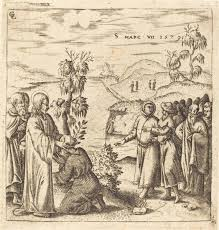
After being presented with the man, Jesus took him aside and put his fingers in the man’s ears, and then spat and touched his tongue before he looked to heaven for help as he offered a deep heartfelt prayer.

In Jesus’ culture human spittle was a healing agent. Without expounding on all of the details, we should notice that it is not the spittle itself that heals. Jesus did not spit directly on the tongue. Rather, he spat and then touched the man’s tongue. This physical contact is clearly appropriate for a man who was unable to hear the spoken word.

Furthermore, it is not just the spittle and the touch that cured. Jesus’ word accompanied both.[5] Jesus did not utter gibberish, but plainly spoke his command not to the ears, but to the man. Yet, in effect the ears were commanded to hear again.[6] Although the man was deaf, Jesus spoke the command and the effect was immediate. Deafness and dumbness are cured at once.

In Jesus, Scripture was fulfilled. We are reminded of Isaiah’s prophecy, “Then the eyes of the blind shall be opened, and the ears of the deaf unstopped; then shall the lame man leap like a deer, and the tongue of the mute sing for joy. For waters break forth in the wilderness, and streams in the desert.” (Isa 35:5-6) But we can also see an earlier prophecy in Exodus when “Moses said to the Lord, ‘Oh, my Lord, I am not eloquent, either in the past or since you have spoken to your servant, but I am slow of speech and of tongue.’ Then the Lord said to him, ‘Who has made man’s mouth? Who makes him mute, or deaf, or seeing, or blind? Is it not I, the Lord?’” (Ex 4:11) There is also this, “Wisdom opened the mouths of the dumb and made eloquent the tongues of babes.” (Wis 10:11)

The crowd’s astonishment is dramatically expressed. The Jewish Messiah is met with wider approval and praise and paves the way for a crowd of 4,000 to follow him to a deserted area where he will feed them.[7] That said, let’s move to my third B, Beyond Measure.

Every once in a while, I ask a friend to comment on a passage. In this case, I asked my friends, Bob and Ruth Sattler, to tell me how they were moved Beyond Measure through their daughter, Liz. Liz was born with Down’s Syndrome and her life had a tremendous influence on their lives – beyond their wildest dreams.

I thought of Bob and Ruth because they once told a story of when they were installed as Eucharistic Ministers at Word of God Parish in Swissvale, they returned to their seats. Up until this point, nothing extraordinary. What happened next was.

Liz stood on the pew, put her arms around both and said, “I am so proud of you.” They went on to mention all the doors that were opened to them and how they met so many people through Liz and Down's Syndrome. My question: How did God astonish you beyond measure through Liz? Here is how Ruth responded.

Yes, Liz certainly has opened many doors for us. I would say I have learned so much about what it means to love someone because of having Liz in my life! Liz has led me to many personal insights and positive changes. We love Liz. She has astonished us beyond measure through her own growth and development. Bob and I have described how Liz “brought us to our knees.” While she was so adorable, she also could be stubborn and resistant to change. Rather than having it be a continual power play, we chose to learn how to work with Liz and guide her to be more and more in charge of her actions and behavior. This is something we continue to do in our relationship with Liz. And we have seen her move beyond her own anxiety and comfort zone. She has grown in her ability to accept change and take on new challenges albeit at her own pace, with our help and the support of others in her life. I know that giving birth to Liz and parenting Liz has given God many opportunities to help me “open my ears” or to Be Opened. God, through Liz, has astonished me beyond measure through my own growth and development and ability to love since having Liz in my life! 

I read you Ruth’s words because sometimes we don’t know why life is the way it is for us. We want to know why a child was born with a disability. Why babies are aborted. Why my spouse was unfaithful. What I did to deserve this. I cannot answer any of those questions for you, and I can tell you that you may not find the answer you want in the Bible, however, you may find insight and solace.[8] And reflecting upon the story of faithful Christians like Bob and Ruth, you may find hope.

So, my friends, I was going to end it there, but then my study provided me with a challenging question regarding the crowd of 4,000 who witnessed this healing and then followed Jesus into the wilderness.[9] Are followers of Jesus in it only for the fringe benefits? The healing stories of Jesus raise this question for anyone who claims to be a follower. Am I a Christian only for the fringe benefits? In a world of instant everything, not all good things can be had immediately, especially when we are talking about healing. God does not provide instant answers to anyone all the time. Even Jesus did not always produce instant miracles on demand – not even for Bob and Ruth. But along the way, wisdom comes to those who remain faithful to God in spite of life’s circumstances. That is why we must cling to Christ, His Word and His Sacraments.

Friends, Jesus crosses every boundary imaginable to help you and everyone who comes to him in faith. God took on human flesh and crossed the boundary from the divine to the human realm. Jesus opened the ears and mouth of a deaf mute and beyond measure amazed others. This week recognize the Good News of how Jesus crosses unfathomable boundaries to offer you salvation, which includes healing of body, mind and soul. We are the ones who need to hear, “Ephphatha!” Be open! Whatever your circumstances, Be open to the Holy Spirit working in your life today, and when you do, may the peace of God which surpasses all understanding keep your hearts and minds in Christ Jesus. Amen.


[1] Witherington, p. 252.

[2] Oden, p. 103.

[3] See Mark 9:14-29.

[4] R. T. France, The Gospel of Mark: A Commentary on the Greek Text. Gand Rapids, MI: William B. Eerdmans Publishing Company (2002), p. 300.

[5] Voelz, p. 488.

[6] France, p. 304.

[7] France, p. 304. See Mark 8:1ff.

[8] See John 9, Matthew 2:16-18, Hosea, Job.

[9] Witherington, p. 252

Thursday, August 22, 2024

Traditions


God’s grace, peace and mercy be with you. My sermon is entitled Tradition and my focus is our Gospel (Mark 7:1-13). Let us pray. Heavenly Father, the psalmist wrote, I rejoiced when they said to me, ‘Let us go to the house of the Lord.’”  Now that our feet are within your gates, we rejoice to hear your Word. As we listen, may your Spirit enlighten our minds and move our hearts to love deeply as Jesus loved. This we pray to you, Most Holy Trinity. Amen.

“Tradition. Without our traditions, our lives would be as shaky as... as a fiddler on the roof!” Tradition is the opening number for Fiddler on the Roof. In the song, Tevye explains the roles of fathers, mothers, sons, and daughters in their village, and how people like the matchmaker, beggar and rabbi contribute to the village. The song establishes the theme of the villagers trying to continue their traditions and keep their society running as the world around them changes.

We have our own traditions, but before I get into them, let me set the stage. I am speaking about religious traditions with an upper and lower-case T, Biblical traditions and personal traditions.

First, tradition with an upper-case T. The word itself means a statement, belief or practice handed down from generation to generation, especially a belief or practice based on Mosaic law. The Latin word tradere means to deliver or hand over. It is from trans meaning over and dare meaning to give.

In the ancient Church, the Latin word traditio meant the act of handing the oral and written instruction given by one person to another. In course of time, it came to refer to teaching not in Scripture. This is, of course, a point of divergence between Catholics and Protestants, and yet, Martin Luther pushed back against some of the more radical reformers who sought to dispose of the Creeds. Unlike Catholicism, the Lutheran Church does not believe that Tradition is a carrier of the Word of God, or that only the Bishop of Rome has been entrusted to interpret the Word of God. The Augsburg Confession (XXI) reminds us that in our teaching nothing departs from the Scriptures. The Creeds and Sacraments – Baptism and Eucharist – fall into that teaching.

We retain the oral and written teaching of Jesus when we gather for baptism and Divine Worship. We cannot change the words when baptizing or praying over the bread and wine for they are not ours but His. However, we do have to consider that the oral teachings of Jesus were handed down from Apostles to Paul, Jude and the writers of the Synoptics Gospels – Matthew, Mark and Luke. And at the end of John’s Gospel, we read these words, “Jesus did many other things as well. If every one of them were written down, I suppose that even the whole world would not have room for the books that would be written.” (21:25)

That said, we move from the word tradition to tradition in our passage today. As Jesus went about his ministry of healing, Pharisees team up with scribes from Jerusalem to pose an accusatory question. Pharisees were members of a renewal movement that sought to restore God’s favor to Israel by advocating strict observance of the law and total separation from all Gentile defilement. Scribes were professional copyists and scholars of the law, some of whom were also Pharisees. Those from Jerusalem carried the extra weight of authority.

The gist of their accusation was that Jesus’ followers ate with unclean hands. This is not a hygiene problem but one of ritual purity, which Marks explains in verses 3-4. Biblical rules of ritual purity applied only to the priests serving at the altar, but the tradition developed by the Pharisees extended them to govern the behavior of all Jews at all meals. This made every meal a religious act and a symbolic expression of Jewish identity. Contact with any potentially unclean persons or products in the marketplace meant ritual washing before eating. Jesus’ accusers considered this tradition of the elders to be binding on all Jews.

We see that Jesus calls them hypocrites, the original promoters of false news because their rituals were not rooted in an interior conversion of the heart. After quoting and fulfilling Isaiah’s prophecy in their presence, Jesus indicted them for neglecting what is truly of God in favor of their own agenda.

Jesus did not reject tradition per se for it was important in the early Church to hand on the teachings of Jesus and the Apostles. Rather, he rejected mere human traditions that are not based in God’s word, traditions that negate the intent of God’s word. Paul encouraged believers to “stand firm and hold to the traditions that you were taught by us, either by our spoken word or by our letter.” (2 Thes 2:15)

As we apply this passage to our lives today, we sometimes see or may even adopt religious practices that are often superficial and routine especially among those who have not been adequately evangelized and whose faith fails to impact their choices and behavior in any significant way. Jesus spoke of an attitude toward God that he saw in the scribes and Pharisees and that can be found among Christians in every church: the tendency to substitute religiosity for genuine obedience to God and His Word. What is needed – and perhaps what we need – is a personal encounter with Jesus leading to a deep transformation of the heart. When that occurs, religious practices come to life and serve their true purpose.

Finally, your own traditions. Family traditions are often celebrated and sometimes taken for granted. Some grow in popularity and others shrivel away unnoticed. What practices did your parents and grandparents exercise regularly that still or no longer exist?

By now, most of you know my background growing up in Beaver County, and how we were active in church and the Polish club. What was handed over to me through these experiences remain influential in my life, and I share those traditions with family members. Praying with others at meals and talking freely about what we believe and treasure. Periodically making our grandchildren listen to polkas and teaching them how to dance. Last week when all of our grandchildren were at our home, we prepared a Polish dinner: pork, sauerkraut, pierogies and blintzes.

I could go on, but enough about me. How about you? What traditions you share with others – children, grandchildren, nieces and nephews, friends, family and neighbors. Whatever they are, I am sure that they are all fine traditions; but how do your traditions relate to our faith? I ask that after searching the web for family traditions. I found things like Taco Tuesdays, Friday Night Breakfast, Thanksgiving football and endless lists of family activities, but none of them were tied to why we should do these things.

It then dawned on me that the Passover Meal celebrated by Jews today holds a great example for Christians. Why? Because there is a point during the meal when the youngest person asks four questions beginning with, “Why is this night different from all other nights?” The questions are designed to pique a child's curiosity about what is happening in order to hold their attention.

So, if a young child would ask why are we displaying a manger scene under the tree or on the mantle, or why are we coloring eggs at Easter, or serving particular foods on certain holidays, our answer should have its root in Christ and what He did for us.

Let me close with a person who was handed a tradition, re-envisioned it and re-presented it to others. His name was Paul, and he was very influential in the early Church. Perhaps you heard of this man. Earlier, I cited John 21:25, and that the oral teachings of Jesus were handed down from Apostles to Paul and the writers of the Synoptics Gospels. Jesus died and rose in 33 AD. Mark and Matthew were written around 70 AD. Paul’s Letter to the Thessalonians is the earliest New Testament piece of literature, written about 50 AD. That means before the gospels were written, people heard the Gospel for nearly 40 years from people like Barnabas and Paul.

After his conversion, Paul spent 15 days with Peter (Gal 1:15), and derived information from the traditions of early churches – Jerusalem, Damascus, Antioch – but anything that was handed to him was always transformed by Paul’s personal vision and insight. While his proclamation of the Gospel is nothing like the Evangelists, Paul explicitly called attention to the fact that he handed on what he received.

We read in 1st Corinthians, “Now I commend you because you remember me in everything and maintain the traditions even as I delivered them to you. … For I received from the Lord what I also delivered to you … I would remind you, brothers, of the gospel I preached to you, which you received, in which you stand, and by which you are being saved, if you hold fast to the word I preached to you—unless you believed in vain. For I delivered to you as of first importance what I also received.” ( 1 Corinthians 11:2, 23; 15:1,3)

Paul appealed to the customs of the churches and recommended fidelity to tradition. To the Thessalonians, he wrote, “We thank God constantly for this, that when you received the word of God, which you heard from us, you accepted it not as the word of men but as what it really is, the word of God, which is at work in you believers.” (1 Thes 2:13) To the Philippians, “What you have learned and received and heard and seen in me—practice these things, and the God of peace will be with you.” (4:9) And to the Corinthians, “I commend you because you remember me in everything and maintain the traditions even as I delivered them to you.” (1 Cor 11:2)

Even though Paul gives no evidence of having known Jesus personally in his earthly ministry, what is of great importance is that he emphasized the salvific effects of Christ’s passion, death and resurrection, which for him transcend the data of the historical ministry of Jesus. His interest was in these climactic events of Jesus’ career rather than on the details of His lifestyle, ministry, personality or even his message. …  Paul was interested in the exalted, risen Lord, who became the real agent of the tradition developing in the heart of the apostolic church.

My friends, I tell you this because God’s Church, God’s world needs to hear the Gospel of Jesus Christ today more than ever, and that is dependent not only on the written Word of God, but more importantly upon you. As a friend of mine always said, “You may be the only Gospel people hear.” Whatever traditions you incorporate into your family life and share with others, make sure that it includes the Gospel – that Jesus Christ lived, taught and healed, that He embraced violent suffering and death for you, that He handed onto you His Body and Blood, and that after He died on the Cross, descended into hell, rose from the dead and with the Father sent the loving Holy Spirit to you. Link every family tradition to what was handed on to you as it was to Paul. And when you do, may the peace of God which surpasses all understanding keep your hearts and minds in Christ Jesus. Amen.

Friday, August 16, 2024

BREAD


Do you like bread? I love bread. There are so many different kinds of bread: white, wheat, rye, pumpernickel, sour dough. There are many ways bread can be formed: sliced sandwich bread, dinner rolls, hoagies, sticks, and so on. Pizza is a form of bread. So are tacos. That’s not even counting pastries and donuts.

I mention bread today because over these weeks, we are hearing from the Gospel of John, Jesus speak about himself as the Bread of Life. Now, there are many healthy benefits to eating bread, but none can compare with the Bread of Life, Jesus’ Body.

As Lutherans, we believe that Jesus’ Body is truly present in the bread we receive at communion. He’s present in, with and under the bread. Some people do not believe that. Some believe that the bread is no longer bread, but becomes Christ’s flesh entirely. Others believe that because Jesus is sitting at His Father’s right hand in heaven, he cannot be in the bread.

To that, all I can say is, we are right, and they are wrong. We believe that Jesus is present in the bread and wine and offers us strength and comfort.

With that, let us pray. Heavenly Father, from whom all fatherhood in heaven and earth is named: Bless these and all children, and give their parents the spirit of wisdom and love, so that the homes in which they grow up may be to them an image of Your Kingdom, and the care of their parents a likeness of Your love. We pray in the Name of the Father and the Son and the Holy Spirit. Amen.

Wednesday, August 14, 2024

Our Belief about the Body of Christ


God’s grace, peace and mercy be with you. My sermon title is What the Body Believes about the Body, and my focus is our Gospel (John 6:51-59). Let us pray. Heavenly Father, the psalmist wrote, I rejoiced when they said to me, ‘Let us go to the house of the Lord.’”  Now that our feet are within your gates, we rejoice to hear your Word. As we listen, may your Spirit enlighten our minds and move our hearts to love deeply as Jesus loved. This we pray to you, Most Holy Trinity. Amen.

Body. When I say the word body, what is your first thought? I begin with that question because the word is used in numerous ways. My doctor advises me to care for my own physical body by keeping a good diet and getting plenty of exercise. I can use the word as a descriptor by saying, “He had a fat body but thin arms and legs.”

If my car is involved in a fender bender, I take it to an auto body repairman. A group of people join together to form a student body or an advisory body. Justice Antonin Scalia left behind a body of work as his legacy. An ocean or a Great Lake is known as a body of water. So, when I entitle my sermon, “What the Body Believes about the Body,” I make three points: church body, what we believe about our Gospel, and the Sacrament.

Body of Christ is a way of naming and connecting Christian experiences: the physical body of Jesus of Nazareth; the reality of the Resurrected Christ; the community of Jesus’ followers in communion with Him and one another; and the presence of Christ in the Eucharist or Lord’s Supper.[1]

When St. Paul began using the word body to name the covenanted people or the Church, he relied upon his Hebrew experience. The origin of that is Joshua 7, a strange, barbaric, but remarkable tale which shows how the people of Israel belonged to one another. We find it strange because our culture interprets reality differently. We think of ourselves as unconnected individual persons until some attraction or tragedy occurs. Friendship develops because we are neighbors, coworkers, classmates or teammates. It also occurs when we band together after a tragedy. When surviving family members from 9/11 met, they bonded as one. When a person in a congregation suffers an accident or death, individual Christians come together. 

But St. Paul was a Jew, and his interpretation of human reality was in rooted in his background. His conversion experience[2] describes how he was on his way to persecute Christians, and in a white-hot moment of divine revelation, God spoke to him: “Why are you persecuting me?” The answer to his question, “Who are you?” was “I am Jesus whom you are persecuting.” He eventually understood that his persecution of this body of people was actually the persecution of Jesus Christ. He then began to teach Christians that because through baptism and the Lord’s Supper we are physically joined to Jesus Christ, there are moral and immoral activities. There are rules for living. As members of this Christian body, the Church, we can eat whatever food we choose, but we cannot engage in sexual activity with another unless we are married to that person, because, as Paul wrote, “Do you not know that your bodies are members of Christ?” (1 Cor 6:15)[3] As individual Christians, we are joined to Christ and to one another, and as individuals, we must avoid giving scandal not only to one another, but also to unbelievers who seek to dishonor and destroy us.

The Body of Christ (His Church) embraces and transforms us into one people. Baptism makes us all equal. There is no privileged hierarchy in our Church. St. Paul wrote about this in Galatians 3:25-29, where we read that “you are all one in Christ.” We lay that teaching next to what Paul wrote regarding different ministries in 1 Corinthians 12:27-30, to understand that not all of us can be apostles, prophets, teachers or healers. These two parallel teachings are in accord with Jesus’ teaching to his disciples, which ends with, “Whoever exalts himself will be humbled, and whoever humbles himself will be exalted.” (Mt 23:12)[4]

My point is that as the Body of Christ today, our beliefs about almost anything are rooted in Scripture with a whole history of discussion and debate, councils and creeds, arguments and anathemas. The Church has something to say not only about worship on Sunday, but also about moral and immoral living throughout the rest of the week when we interact with one another and others, believers and unbelievers. We are the Body of Christ, and we remain intimately connected to Jesus Christ and one another.

Now, what if I choose to separate myself from this Mystical Body? In 1st Corinthians (12:12-26), Paul teaches that being connected to Christ once means being connected eternally. Whether it likes you or not, your big toe does not get to decide it’s no longer going to be part of you because you stub it so often. It is connected whether it likes it or not. In a like manner, we do not get to decide if we are connected to the Body of Christ or not. We are. Being baptized into the suffering, death and resurrection of Jesus Christ redeems our connectedness and deepens it beyond anything I can describe.

Like you, I sometimes ponder if I am connected to all of you. You may feel more closely connected to your dog than to the people sitting around you, and if that is the case, let me ask you: When did you last take home the bulletin to pray for the people listed in it? When is the last time you had free time and reached out to another member of this Body? Is your time during the coffee social spent talking to people you do not know well or do you always sit with the same people? When is the last time you laid awake at four in the morning and prayed for all the people around you and the people who have not yet returned to this church? If I do not feel connected, have I tried to understand my connection to everyone else in the Church the way Paul did after his white-hot experience with the Living Person of Jesus Christ? Remember, Paul’s personal relationship with Christ eventually led to his communal and cosmic relationship with our Triune God, His universal Church and all of creation.[5]

On to my second point, Believe. What do we believe about what Jesus said in the Gospel today? To believe is to accept that something is honest or true. It also means that I accept someone’s word or the evidence. Since the Greeks put stock in the teaching of the ancient ones, we begin with some of the early Church Fathers before going to the text itself.

When some challenged Jesus’ statement, they asked, “How can this man give us his flesh to eat?” St. Cyril of Jerusalem stated that we should not think of the bread and wine as mere physical food. “In accordance with the Lord’s declaration, they are body and blood. If our senses suggest otherwise, let faith confirm you. Do not judge on the basis of taste, but on the basis of faith be assured beyond all doubt that you have been allowed to receive the body and blood of Christ.”[6]

When Jesus responded to his critics, St. Cyril of Alexandria taught that the “power of learning follows on those who believe. … Faith should first be rooted in [belief] before understanding.”[7] A more recent author wrote that when Jesus speaks of eating his flesh and drinking his blood, it means the whole man, which is why we receive Eucharist under both species. In faith, we receive the whole Christ.[8]

Now, why did Jesus say that his flesh is true food and his blood real drink? First of all, Jesus was not contrasting his flesh and blood with manna in the desert. Rather, He insisted on the genuine value of his flesh and blood as food and drink. Eating and drinking the whole Christ and receiving His abiding presence into our lives harkens to the vine and branches statements Jesus spoke, for that too is eucharistic. St. John echoed this in his first letter, where we read, “God sent his only Son into the world, so that we might live through him.” (1 Jn 4:9)

There is no Last Supper scene in John’s Gospel like those in the Synoptics; so, when you read chapter six, read it this way. Think of Jesus explaining to his disciples just what he meant when he gathered around the table with them and said the words of institution. In Matthew, we read that after blessing and breaking the bread, Jesus gave it to his disciples and said, “Take, eat; this is my body.” He took the cup, gave thanks, and then after he gave the cup to them said, “Drink of it, all of you, for this is my blood of the covenant, which is poured out for many for the forgiveness of sins.” (Mt 26:26-28) St. John was inspired by the Holy Spirit to write this section as a way for us to understand not only what happened at the Last Supper, but also what happens each time we take the Lord’s Supper in church, in the home of a homebound person, or in the nursing home or hospital.

This Bread of Life teaching (John 6) represents a convergence of Jesus’ twofold presence to believers in the preached Word and in the Sacrament of the Eucharist. This twofold presence is the structural skeleton of our liturgical service. Imagine Jesus standing before you explaining what it is we are doing here when we worship. Through Word and Sacrament, we who have an individual personal relationship with Jesus are made one with Him, the Father, the Holy Spirit and one another – even those who we need to forgive – every time we take the whole Christ in Holy Communion.

That brings me to my third point in What the Body Believes about the Body. As Lutherans, we take Christ’s words “This is my body” and “This is my blood” at face value. He spoke those words, and as His last will and testament, we cannot change them. We also find them in Paul’s Letter to the Corinthians (1 Cor 11:25). We believe and teach that the presence of Christ’s body and blood are in, with and under the bread and wine, In reminds us that where the bread and wine is, there is the body and blood of Christ. With reminds us that with the bread and wine we receive the body and blood of Christ. Under reminds us that the body and blood of Christ are hidden yet present since the bread and wine continue to exist. If I put a napkin or cloth over a loaf of bread, the bread under the napkin is still present even if I cannot see it.

The reason I point out what we read in the Small Catechism is because not all Christians believe this. Catholic transubstantiation means that that Christ’s body and blood replace the bread and wine. The Reformed Churches, those that are based upon the teachings of Zwingli and Calvin, do not believe that it is possible for Christ to be at the right hand of the Father in Heaven, and in the bread and wine. They teach that the bread and wine in the Lord’s Supper are not Christ’s Body and Blood, but only symbols. We accept what Christ said, and do not change the meaning of His word “is” to “symbolize”.

At a recent study session, one of the pastors noted this difference as written in the Book of Concord, adding that many Protestants point out the errant teaching of Catholicism, but fail to see the danger in Calvin’s teaching that Christ cannot be present at the Lord’s Supper. If Christ is not present, how does He offer comfort to us, and how do we offer thanksgiving to Him?[9] “The Sacrament was instituted to comfort terrified minds. This happens when they believe that Christ’s flesh is given as food for the life of the world (Jn 6:51) and when they believe that, being joined to Christ, they are made alive.”[10] Martin Luther and the Fathers of our Evangelical Church remind us to believe Christ’s words that He is in the bread and wine for the forgiveness of our sins. They also remind us that the act of eating and drinking His body and blood assures us not only of the forgiveness of our sins, but also everlasting salvation.[11]

I have recently completed a biography on Luther in which the author points out that for Luther “the Real Presence of Christ in the Mass (Worship) was not something that could be explained.” As the controversy created by Zwingli and Calvin continued, “it became clear that insisting on the Real Presence was a fundamental part of Luther’s theology.”[12]

That Christ is truly present is not only Luther’s teaching, but we can cite others such as Augustine, John Chrysostom, Irenaeus, St. Paul and Christ Himself. But what does an understanding of Christ’s Real Presence in the Sacrament have to do with our daily living? It has to do with the realization that as each of us consumes the whole Christ in the Sacrament, we are made one with Christ and one another. We go from being 50 or 80 individual believers to one body of believers. In this Sacrament, Christ makes us one Body.

Earlier I spoke about Paul’s view of human reality and how he came to see that we are the Body of Christ. Several weeks ago, I spoke about how little time we spend in prayer each day, less than ten minutes per day. I asked if you take home the bulletin and pray for those people listed in it. And providentially, some one sent me a link to a sermon, in which the pastor asked the same question to his church members: How much time do you pray for the Church?

Praying for my own needs is too small for us. Praying for the needs of others is what we should be doing. I pray for the needs of others, and the greatest need you and I have is an intimate relationship with Jesus Christ, His Father, the Holy Spirit, the saints of the church (one another), and the world’s sinners because Christ came to redeem all of mankind. Friends, when you pray for me and one another, pray that all the people you know and do not know experience a dynamic relationship with Jesus Christ and His brothers and sisters. When you do, may the peace of God that surpasses all understanding keep your hearts and minds in Christ Jesus. Amen.


[1] Bernard Lee, “Body of Christ,” The New Dictionary of Catholic Spirituality. Collegeville MN: The Liturgical Press (1993), p. 100.

[2] See Gal 1: 12-17; Acts 9:1-14; 22:5-16; 26:10-18.

[3] See chapters 5-8.

[4] See Mt 23:8-12.

[5] See Ephesians 6:12; Roman 1:20; Colossians 1:15-20.

[6] Ancient Christian Commentary on Scripture: New Testament IVA John 1-10, Ed Joel C. Elowsky. Downers Grove IL: InterVarsity Press (2006), p. 239

[7] Ibid.

[8] Brown, 282.

[9] The Apology of the Augsburg Confession, Article XXIV: The Mass, Par. 75.

[10] Apology, Article XXII: Both Kinds in the Lord’s Supper, Par. 10.

[11] Formula of Concord: The Solid Declaration, Article VII: The Holy Supper, Par.62ff. See also the Small Catechism, Question 362.

[12] Lyndal Roper, Martin Luther: Renegade and Prophet. New York: Random House (2016), p. 280

Friday, August 9, 2024

MAGNIFY GOD!


Do you know what a magnifying glass is? It’s a piece of glass or lens that makes something look bigger. The lens of the magnifying glass is thicker than plain glass and makes objects appear larger than they really are.

If you look at the words on this piece of paper, they appear normal. Now, if you place this magnifying glass between the paper and your eye and look at it again, the words appear bigger.

I show this to you because in our Psalm today (34:1-8), we hear the words “magnify the Lord with me.” … Doesn’t that sound strange to you? How can we magnify the Lord? Can we look at God through a magnifying glass?

The Psalmist didn’t mean that we make God larger than He is like we make the words on this page larger than they are. But if I make something larger, then do I become smaller?

How about this for an example. In my sermon last Sunday, I mentioned Sydney McLaughlin. She’s the young woman who won the Gold Medal at the Olympics in the 400-meter hurdles. After she won, she gave all the praise to God. Her prayer is: “God, let me be the vessel in which You’re glorified, whatever the result is — how I conduct myself, how I carry myself, not just how I perform.” She magnified the Lord, and humbled herself. She made God greater and herself smaller.

You can be a star and be humble when you magnify God, but you don’t have to win a medal to start. You can praise God for your looks or grades, your athletic ability or musical talent. If you don’t have those, you can praise God for creating and loving you.

With that, let us pray. Heavenly Father, from whom all fatherhood in heaven and earth is named: Bless these and all children, and give their parents the spirit of wisdom and love, so that the homes in which they grow up may be to them an image of Your Kingdom, and the care of their parents a likeness of Your love. We pray in the Name of the Father and the Son and the Holy Spirit. Amen.