Wednesday, June 5, 2024

Biblical Sandwiches


God’s grace, peace and mercy be with you. … My sermon is entitled “The Marcan Sandwich” and my focus is our Gospel (Mk 3:20-35). Let us pray. Heavenly Father, the psalmist wrote, “I rejoiced when they said to me, ‘Let us go to the house of the Lord.’” Now that our feet are within your gates, we rejoice to hear your Word. As we listen, may your Spirit enlighten our minds and move our hearts to love deeply as Jesus loved. This we pray to you, Most Holy Trinity. Amen.[*]

One of my favorite foods is the sandwich. Ham, turkey, tuna, roast beef, grilled cheese, BLT or PBJ between two slices of white, wheat, rye, pumpernickel, sour dough, French or Italian bread with condiments, vegetables, even fried eggs in between. The sandwich is a meal for anytime at the table, in front of the TV, at a family picnic or while commuting to work.

Sandwiches predate the 4th Earl of Sandwich, John Montagu, by 18 centuries. One hundred years before Christ, the famous Jewish leader, Hillel the Elder, ate flat bread sandwiches filled with sliced lamb, a practice that spread to Western Asia and North Africa. And I am guessing that no one else here besides me has been to Sandwich, Illinois, one of the three towns named Sandwich in America.

I speak of the sandwich, because it is a literary technique characteristic of Mark in which one story is inserted in the middle of another so that each illuminates the other. Mark served sandwiches to Christians orally and in print. Today’s passage is one of 12 found through Mark. In fact, the entire Gospel of Mark is one massive sandwich with 8:29 as the real meat: And he asked them, “But who do you say that I am?” Peter answered him, “You are the Christ.”

In today’s gospel, three scenes are arranged into one block of material. In the first and third units, Jesus is misunderstood by his own family; the second (vv. 22-30) involves a far more serious charge from the religious authorities. As we unpack our sandwich, I would like to look at three ingredients: brother, blasphemy and believer, before returning for another sandwich.

First, brother. Our passage opens with Jesus returning home. From the words Jesus spoke throughout his ministry, home should be the place where one is welcome. After Jesus healed the Gerasene demoniac, he instructed him to go home to his people and tell them how much the Lord did for him and what mercy He showed him. In Matthew, after he healed the paralytic, Jesus told the man to pick up his bed and go home. In Luke 15, the father welcomes home his lost son with a king’s feast. Here, however, his family and friends, including his brothers, seek to restrain him or control him.

To understand the reaction of Jesus’ relatives, it is important to recognize what family bonds meant in their social context. An individual existed only as part of an extended family unit, whose authority structure, obligations and customs governed every aspect of life. Any action by an individual was a reflection on the whole family, and any breach of family honor would meet with severe discipline. Since Joseph was no longer alive, Jesus would have to answer to his uncles and senior cousins.

These “brothers” heard that people were saying that Jesus was out of his mind, in other words, mentally ill, often associated with demonic influence. Motivated to protect him from hostile religious leaders, they set out from Nazareth on a 20-mile trip to seize their ordinary young kinsman because they did not believe in him. In v. 31, we learn that Jesus’ brothers arrived, but finding it impossible to get near him they stood outside. Because our passage is a sandwich, we will return to it later. For now, we move from the outside to the inside, from brothers to blasphemy.

The inside passage of Mark’s sandwich transitions from brothers from Nazareth to scribes from Jerusalem. Sent by the authorities to check out rumors concerning this miracle worker, these experts in the Mosaic law carried more weight than the Galilean Pharisees, Jesus’ fiercest opponents. Their chilling verdict is categorical: “‘He is possessed by Beelzebul,’ and ‘by the prince of demons he casts out the demons.’”

Notice how Jesus responded. He summoned them, suggesting that they were saying these things behind his back, and confronted them face to face, answering their charges in reverse order. To their claim that he was using demonic powers to cast out demons is logically absurd. What king would instigate a revolt against his own rule? If this were so, Satan’s dominion would have collapsed.

In his second statement, Jesus used a burglary analogy. The strong man Satan guarding his illicitly obtained belongings, that is, possessed human beings, must first be subdued in order for his house to be plundered. Recall Isaiah’s prophecy where we read: “Can they seize plunder from warriors, or can the captives of tyrants be rescued? But this is what the Lord says: ‘He will seize even the warriors’ plunder, and the captives of tyrants will be rescued. I myself will quarrel with those who have a quarrel with you, and I myself will save your children.’”

Finally, Jesus addressed the scribes’ first charge that he is possessed by Beelzebul not with a parable but with a somber warning. He prefaced his affirmation that all sins, even blasphemy, are forgiven with an Amen, a completely new usage of a word that concludes prayers as an expression of agreement. The closest expression in the Old Testament to Jesus’ phrase, “Truly I say to you,” is the phrase, “As surely as I live,” found in Numbers, Isaiah and Ezekiel.

Blasphemy is the act of insulting or showing contempt or lack of reverence to a deity, to religious or holy persons or sacred things, or toward something considered sacred or inviolable. The word "blasphemy" came from two Greek words meaning injure and utterance, talk or speech. In the sense of speaking evil of God this word is found in Psalm 74: Remember how the enemy has mocked you, Lord, how foolish people have reviled your name. In Romans 2, Paul borrowed a verse from Isaiah who proclaimed: What is this? asks the Lord. Why are my people enslaved again? Those who rule them shout in exultation. My name is blasphemed all day long.”

Although abusing or insulting the name of God is a sin against God himself, this is forgivable. What Jesus said here is that blasphemy against the Holy Spirit meant to harden your heart so completely that one defiantly refused to recognize the action of God and attributed to evil the good works Jesus did in the power of the Spirit. For we see that when Jesus came up out of the water after he was baptized, immediately he saw the heavens being torn open and the Spirit descending on him like a dove. The scribes who persisted in such willful blindness refused to repent and chose to close themselves to the forgiveness that God offers through Jesus. Now, note that Jesus did not condemn the scribes of committing this sin but warned them of the grave danger that awaited them if they did not open their hearts to the Spirit and repent.

Finally, believers. After the incident with the scribes, Mark resumes the account of Jesus’ brothers who set out to seize him but found it impossible to get near him. Mark highlighted the contrast between Jesus’ family and the audience surrounding him by twice mentioning that his family members stood outside.

This is the only time in Mark that Mary, the Mother of Jesus, appears on the scene. Mark did not indicate that she shared the opinion of those who thought Jesus was out of his mind, but the episode suggests that she did not fully comprehend the scope and significance of her son’s mission. Like others, she must grow in understanding of the divine mystery that only faith can penetrate. Here, as in the finding of the temple and at the foot of the cross, she must undergo a certain detachment in her far greater role in the new family Jesus established. In Acts we read, “All these with one accord were devoting themselves to prayer, together with the women and Mary the mother of Jesus, and his brothers.”

But when he received word that his family was calling, Jesus immediately interrupted his teaching to answer their summons. His reply must have sounded shocking in the cultural context I described earlier. It is the first indication that all earthly ties take second place to the kingdom of God. We hear Jesus speak this again in chapter 10, “Truly, I say to you, there is no one who has left house or brothers or sisters or mother or father or children or lands, for my sake and for the gospel, who will not receive a hundredfold now in this time, houses and brothers and sisters and mothers and children and lands, with persecutions, and in the age to come eternal life.” In other words, Christian discipleship trumps family ties.

Then, gazing with affection and intimacy at those seated around him, Jesus elevated his new family to an unexpected status. His new family, the family of believers, united around him in a bond of love, familiarity and loyalty was stronger than any blood relationship. For we read in John’s Gospel, “to all who did receive him, who believed in his name, he gave the right to become children of God.” This is restated in Hebrews, Romans and Ephesians, “You are no longer strangers and aliens, but you are fellow citizens with the saints and members of the household of God.”

Establishing a new community of believers was not a rejection of his earthly family. Eventually, his brothers accepted the new basis of kinship evident from what I read in Acts.

Jesus’ final statement, “whoever does the will of God, he is my brother and sister and mother,” explained the foundation for his new family. Jesus’ most heartfelt desire was to please His Father. The only condition for entering God’s family is to do God’s will, just as Jesus did. And to do God’s will, one must first learn what it is by sitting and listening to Jesus as the crowd is doing. By doing God’s will, they in a real sense bring Jesus into the world.

As believers, we are brothers and sisters who bring Jesus into the world. We do so by first sitting and listening to Jesus and doing God’s will. That should be our heartfelt desire. To bring Jesus into the world, to nourish others with the Gospel, we must be nourished daily. And so, in closing I ask you, what is your favorite spiritual sandwich?

Think of your spiritual sandwich as your day. How do you start and end your day, and what happens during the in-between moments? I start my day reading psalms, Scripture passages, and early Christian writings from people like Athanasius, John Chrysostom, Ambrose and Augustine. At the end of the day, I reflect, read a shorter psalm and Scripture passage and pray that Almighty God bless us, protect us and bring us to everlasting life. During the day, I sandwich in other times to pray with my wife and whatever family members or friends are gathered with us. I also tend to ponder throughout the day what I read early in the morning. When I feel some sadness or bitterness because of some event that occurs, I view it through the prism of the Cross. When I feel joy, I think how God was responsible for this uplifting moment. Thus, my day is like a spiritual sandwich.

None of our spiritual sandwiches will be the same. We read different Scripture passages and materials. For example, Julia chose as her confirmation verse, John 14:6, which reads, “Jesus said to him, “I am the way, and the truth and the life. No one comes to the Father except through me.” I asked her why she chose that, and she told me that this is meaningful for her because Jesus is the only way to the Father. I think Julia chewed on that verse for quite some time because it took her some time to choose a verse. That’s a good sign.

We also listen to different messages throughout the day. We pray for different people and needs. We experience vastly different moments even if the event is the same. But each day offers us the opportunity to bring Jesus into the world as brothers and sisters seeking with heartfelt desire to please our Father. Brothers may not always understand us. Blasphemers will curse us and our God. Still, we remain steadfast believers listening to Jesus and seeking to do God’s will. Friends, may your spiritual sandwich nourish you daily, and as it does, may the peace of God that surpasses all understanding keep your hearts and minds in Christ Jesus. Amen.


[*]For notes, see an earlier version at https://cwynar.blogspot.com/2021/06/sandwich-stories.html

Saturday, June 1, 2024

CATECHISM


Do you know what this is? This is a copy of Martin Luther’s Small Catechism. It’s called the Small Catechism because Martin Luther first wrote a larger version of this, and it is called The Large Catechism.

Do you know why Martin Luther wrote these two catechisms? He wrote them because as he travelled around Germany, he discovered that parents were not teaching their children the Christian Faith. So, he wrote the Small Catechism for parents, particularly for fathers to help them teach their children.

By the way, the word catechism is a Greek word which means to echo. You know what an echo is. You shout a word and the sound bounces back to you. The catechism echoes the words of Jesus Christ. That means when I teach from this, I teach only what Jesus taught.

Now there are four parts to the Small Catechism: Ten Commandments, Apostles Creed, Lord’s Prayer, and the Sacraments. I mention all of this because our first reading today is the Commandment to keep holy the Lord’s Day, and in my sermon for the adults, I am going to review that Commandment for them and why we should keep it.

We keep it because God loves us so much that He gave us His Son who saved us from Satan, sin and death, and made us His children. We keep the Lord’s Day holy because we love Our Father.

With that, let us pray. Heavenly Father, from whom all fatherhood in heaven and earth is named: Bless these and all children, and give their parents the spirit of wisdom and love, so that the homes in which they grow up may be to them an image of Your Kingdom, and the care of their parents a likeness of Your love. We pray in the Name of the Father and the Son and the Holy Spirit. Amen.

Friday, May 31, 2024

Compare, Catechism, Context


God’s grace, peace and mercy be with you. My sermon is entitled Compare, Catechism and Context, and my focus is our first reading (Deuteronomy 5:12-15). Let us pray. Heavenly Father, the psalmist wrote, “I rejoiced when they said to me, ‘Let us go to the house of the Lord.’” Now that our feet are within your gates, we rejoice to hear your Word. As we listen, may your Spirit enlighten our minds and move our hearts to love deeply as Jesus loved. This we pray to you, Most Holy Trinity. Amen.

Are you a stat head? I was writing the first part of this sermon on Friday, May 24, as I was waiting for my stepson to pick me up to take me to the Pirates-Braves game. He’s a Braves fan, and I wanted to inform him that the Pirates beat the Braves 1115 times, and lost 1050 games. The Braves made 18 World Series appearances, and won 4 times. The Pirates made 9 appearances, and won 5 championships. If you are interested, you can find all these comparisons on stathead.com.

People like to compare everything under the sun: sports teams and players, restaurants, grocery stores, vehicles, religious denominations, apples and oranges. The list is endless. I open with Compare because in a moment, we are going to compare the 3rd Commandment from Exodus and Deuteronomy.

The word compare means to examine the character or qualities of things to discover resemblances or differences. The word comes to us from the Latin comparare, meaning to liken, and is composed of two smaller words. Com means with or together, and par means equal. Look at that, I mentioned two sports in one sermon!

If we compare the second and fifth books of the Pentateuch, we see that Exodus is the account of the going forth from Egypt by the Hebrew people. In addition to that liberation, the book establishes the law and dwelling at Mt. Sinai. Deuteronomy is a law book, and literally means “second law.”

Reading a law book is not something most people do for pleasure. They read it for a purpose. In Deuteronomy, the purpose is to understand justice – in this case that God’s justice may roll down like waters, and righteousness like an ever-flowing stream. (Amos 5:24) Unfortunately, this important point is lost on many Christians. “The purpose of the law is to outline a level of moral performance compatible with the self-revelation of Israel’s God and Israel’s high calling. The care to regulate life by law, one of the chief characteristics of Judaism, is seen in the adaption of an ancient legal tradition to new situations.”[1] This was the case in Deuteronomy, written 40 years after the Commandments in Exodus.

In Dt 16:20, we read, “Justice, and only justice, you shall follow, that you may live and inherit the land that the Lord your God is giving you.” We continue to hear this message not only from the prophets, but also from Jesus. Hence, the law of God in Deuteronomy comes down on the side of widows, the fatherless and aliens.

Unlike the Ten Commandments in Exodus, Deuteronomy’s are prefaced by Moses speaking to the people. He summons them to himself so that they may hear these Commandments, reminding them that they first heard them on the mountain 40 years earlier.

In a side-by-side comparison, the first two Commandments in Deuteronomy (5:6-11) are verbatim of Exodus (20:1-7). But when we get to the Third Commandment, Exodus opens with remember, and Deuteronomy with observe. They both tell us that the seventh day is a Sabbath to the Lord God, and no one, including livestock, is to do any work. Deuteronomy specifies ox and donkey among the livestock, and repeats the importance of servants resting.

While Exodus reminds the reader that God rested on the seventh day after He created the heaven and the earth, Deuteronomy states that the people should “remember that you were a slave in the land of Egypt, and the Lord your God brought you out from there with a mighty hand and an outstretched arm. Therefore the Lord your God commanded you to keep the Sabbath day.” (5:11) So, the first account recalls creation, and the second, the Exodus event, Passover. My study of this passage indicated that unlike the ties of this commandment to creation, Deuteronomy’s is tied to a humanitarian motive. Even if the people did not personally experience their freedom from slavery, Moses reminded them that God did this wonderful thing for you. Therefore, keep the Sabbath holy and it will go well for you and yours.

Now, if you remember from the bulletin, I was at the Pastor’s Conference a few weeks ago. Our speaker was Rev. Dr. Andrew Steinmann, Professor Emeritus of Theology and Hebrew at Concordia University Chicago. When you have a chance to ask a pertinent question to someone of that caliber, you don’t take a pass. I asked him about the two versions of the Decalogue (Ten Commandments) in Exodus and Deuteronomy, especially the 3rd Commandment, and he pointed me to an article he had written last year.[2]

The article analyzed the Decalogue and defended the pedagogical use of it in Luther’s catechisms. Dr. Steinmann concluded that “literary analysis is useful in helping to determine the message and meaning of the biblical text. However, literary analysis is not and should never be the final arbiter of how the Christian faith is taught.”[3] With that, we move from Compare to Catechism.

The people in Deuteronomy did not experience the Exodus as did the previous generation. They needed to be reminded of their faith and what God had done for them. The Decalogue, like Lutheran teaching, is Gospel and Law. God brought forth people from slavery (Gospel) and commanded them to observe and avoid certain actions (Law). 500 years ago, Martin Luther discovered upon his visits to churches that the faith was not being taught by pastors or the fathers in the families. Like Moses, Luther set about teaching the faith to a new generation.

When we turn to the Third Commandment in the Small Catechism, we read, “Remember the Sabbath day by keeping it holy.” It means that “We should fear and love God so that we do not despair preaching and His Word, but hold it sacred and gladly hear and learn it.” Citing the passage of Martha and Mary (Lk 10:38-42), the Catechism tells us that “As Christians, God’s Word leads us to delight in His wondrous works of creation and redemption.” God’s Word opens our eyes to see all of His good works.

Are your eyes opened when God’s Word is read to you when we gather for worship on Sundays? Do you read Genesis or the Psalms and marvel at what God has created for you to enjoy? Do your hearts swell when you hear of the love that Jesus Christ pours out for you on the Cross or in His Last Supper? Do you take to heart a pastor’s sermon or simply tolerate it?

The Small Catechism goes on to explain the Sabbath day and the necessity of rest, as well as the need to read and reflect upon God’s Word. Sadly, there are Christians, and maybe even some who hear or read these words, who loathe and reject Scripture because it is the sole authority on how to live. And so, by devoting ourselves to reading the Word both in private devotion and in public worship, we follow the example of the first followers of Jesus Christ. In Acts, we read, “They devoted themselves to the apostles’ teaching and the fellowship, to the breaking of bread and the prayers.” (2:42)

Today, the significance of the Third Commandment does not require us to observe the Sabbath as in the Old Testament, but it still applies to our Christian life and worship. We need physical rest from our labors. As I have aged, I realized several years ago when I was working for a catering company in Naperville, Illinois, where I loaded and unloaded vans and trucks with food, beverages, dishes and utensils, that my body needed a short rest when I got home. Since I have returned to the area, my property needs constant upkeep. After a full day of working outside, I need a rest the following day. As you age, you may discover the same.

We need physical rest, but we also need rest from the “impossible task of seeking security, righteousness, and salvation through our efforts, works and accomplishments.” The Catechism points to Jesus as the One who calls us to rest a while (Mk 6:31). Our Lord and Master said, “Come to me, all who labor and are heavy laden, and I will give you rest.” (Mt 11:28) He gives us spiritual rest from our sins, and because Christ does so, we will only find it when we are in the Word every day.

But even if we are in the Word every day, we still need to gather together as believers. When the solar eclipse occurred recently, people remarked about the necessity of gathering together to experience it. It is true that there is something special in the gathering with others for events: sports, weddings, funerals, confirmations, military retirements, baptisms, and even family gatherings at Christmas and other holidays. To a greater degree, gathering together for worship where God is present as His Word is proclaimed and His Sacraments are administered through the Means of Grace are most valuable. To hear the voice of the Shepherd through the pastor is not merely informative, but it is care for your soul, the balm of Gilead.

Lastly, we need one another. When I don’t see someone in church for weeks or months, I contact them to see if everything is alright. I am also happy that we have people who take time to visit people confined to their homes or personal care homes.

Friends, if you do not have a Small Catechism, you should purchase one and read it as a devotional book. Now, not many of you have a copy of the Book of Concord, however, it is available online. One valuable work in the Book of Concord is Luther’s Large Catechism. In addition to what is taught in the Small Catechism, Luther reminds us that though the Third Commandment does not apply to Christians in the outward sense, keeping the Sabbath as the Jews did, there is the matter of freedom through Christ to keep it. We keep it because we love God.

Luther reminds us that Sunday has been appointed as the Lord’s Day, and that our way of worship should be orderly (1 Cor 14:40). He writes that since we have God’s Word readily available to us, we should be in the Word not only on Sunday, but daily. Most importantly, as adults, we should teach young people the Commandments, Creeds, the Lord’s Prayer, and the Sacraments, all of which we covered over the past year.

Why should we do this? Luther tells us that the Word sanctifies us righteous men and women. He wrote, “Do not think that [being in the Word daily] is optional for you or of no great importance. Think that it is God’s commandment, who will require an account from you about how you have heard, learned, and honored His Word.”[4] He quotes Romans 14:12, “So then each of us will give an account of himself to God.” There is more that Luther wrote, but let me put it this way for you. Start reading God’s Word. Start trusting God’s Word.

That said, let’s put the Third Commandment into some Context, my third point. I spend a good amount of time in God’s Word. Being in the Word is what I do early in the morning. I spend time reading and praying the Psalms and a chapter of the Bible. I take time to research not only commentaries, but also the sermons of the Church Fathers and Luther.

Why do I spend time in God’s Word? I do so as an act of love for you. It's an act of love because the Word of God is not always comforting, but can be challenging. If I am not reading, studying and contemplating God’s Word to preach it to you, then I bring judgment upon myself by neglecting my duties.

Why should you spend time in God’s Word? I will leave that answer to Luther. “The Word is so effective that whenever it is seriously contemplated, heard and used, it is bound to never be without fruit (Isa 55:11; Mk 4:20). It always awakens new understanding, pleasure and devoutness and produces a pure heart and pure thoughts (Phil 4:8). For these words are not lazy or dead, but are creative, living words (Heb 4:12). And even though no other interest or necessity moves us, this truth ought to urge everyone to the Word, because thereby the devil is put to flight and driven away (Jas 4:7). Besides, this commandment is fulfilled and this exercise in the Word is more pleasing to God than any work of hypocrisy, however brilliant.”[5]

Friends, there is enough hypocrisy around and talkers do little to nothing to benefit our souls. The Bible, however, offers brilliant insights that fulfill our lives. Share God’s Word with your family and neighbors. Share God’s Word especially with the children in your life – your grandchildren and children, your friends’ children and your neighbors’. Invite them not only to our Vacation Bible School, but also to our Sunday Worship. Why should they go elsewhere when the Means of God’s Grace through Word and Sacrament are offered here? Lastly, if you are not reading God’s Word every day, start reading and start trusting. And may the peace of God that surpasses all understanding keep your hearts and minds in Christ Jesus. Amen.


[1] Joseph Blenkinsopp, “Deuteronomy,” The New Jerome Biblical Commentary. Englewood Cliffs, NJ: Prentice Hall, Inc. (1990), p. 95.

[2] Andrew E. Steinmann, “Research Note: On the Numbering and Teaching of the Decalogue,” Concordia Theological Quarterly 87 (2023), pp. 353-357.

[3] Ibid., p. 357.

[4] Concordia: The Lutheran Confessions. St. Louis: Concordia Publishing House (2005). p. 396 ¶98

[5] ¶102

Friday, May 24, 2024

Passage, Presence, Purpose


God’s grace, peace and mercy be with you. My sermon is entitled Isaiah’s Three P’s: Passage, Presence and Purpose, and my focus is our first reading (Isaiah 6:1-8). Let us pray. Heavenly Father, the psalmist wrote, “I rejoiced when they said to me, ‘Let us go to the house of the Lord.’” Now that our feet are within your gates, we rejoice to hear your Word. As we listen, may your Spirit enlighten our minds and move our hearts to love deeply as Jesus loved. This we pray to you, Most Holy Trinity. Amen.

I have preached on Isaiah 6:1-8 previously, and titled that sermon Isaiah’s Three C’s: Confession, Commission and Cost. The passage was for a Sunday early in the Season of Epiphany. Why would the Church employ it now on Trinity Sunday? To answer that question, we turn to my first point, Passage.

Trinity Sunday is the first Sunday after Pentecost. It introduces us to the season when we hear about Jesus’ ministry and our ministry. Although we focus on the doctrine of our belief of a Triune God, none of the readings lays out in explicit terms how the Divine Trinity is structured. Isaiah is chosen for today because of the rare triad in v. 3: “Holy, Holy, Holy.” The early Church considered this to be a Trinitarian formula. However, during the Arian controversy, the Church stepped away from using this text because Arius used it against the Church to support his heretical position that the Three Persons were not co-equal. Arius taught that the Son of God did not always exist but was begotten/made before time by God the Father; therefore, Jesus was not coeternal with God the Father.

Arianism was condemned during the Council of Nicea in 325 AD. From that gathering of bishops, we also have the mainstreamed statement of our Faith, the Nicene Creed. There are remnants of Arianism alive and well in the world today, which is why Christian Churches do not consider as Christian the Unitarians, Jehovah’s Witnesses, and the Church of Jesus Christ of Latter-Day Saints, because they do not believe in a Triune God as the Creeds state. Enough on why we read Isaiah 6:1-8 on Trinity Sunday. Now, let’s look at the passage.

It's rare and unusual to mark an event by the death of an individual. The Ides of March recall the assassination of Julius Caesar, and November 22, 1963 ended not only the life of President Kennedy but a period of time the media dubbed Camelot. Here, the death of Uzziah was symbolic of Isaiah’s view of the nation, its plight and problem. From this point, Judah’s truly hopeless situation emerges.

Isaiah is allowed to see God’s glory, as Jesus stated in John 12:41. Not only did Isaiah describe the Lord’s majesty, but he also expressed the truth that God is present in all his majesty at the Center of people’s lives. The temple is not merely a symbol of God’s indwelling presence, but the reality of it. In the Temple God met his people in the sacrifice.[1]

As Isaiah witnessed the interaction of the seraphim calling to one another, we are reminded of the absolute holiness of the space. The Hebrew repetition of a word indicated totality. And when the angels speak the truth about God – that God is holy – this is so far beyond what we can comprehend that a super-superlative had to be invented to express it. God’s holiness is so complete that the only reaction of anything in His presence, animate or inanimate, is to tremble. Isaiah tells us that the foundations of the threshold shook at the voice of him who called.

Before I move forward, I want you to take a moment and think of this space, God’s house, as absolutely holy. I want you to consider that our awesome God is here. Think of shaking in His presence. Feel your teeth chatter; your knees knock; your legs buckling; and an inability to control your organs. That is how God’s awesomeness made Isaiah physically feel. God’s awesomeness made Isaiah consider that in the presence of a totally holy God, I am a sinner among sinners. And so, he said, “Woe is me! For I am lost, I am a man of unclean lips, and I dwell in the midst of a people of unclean lips; for my eyes have seen the King. The Lord of hosts!”

Isaiah knew how utterly filthy he and his people were that no number of sacrifices could cleanse them. With that, God – using an angel – brought to Isaiah a live coal from the altar. The perpetual fire on the altar went beyond symbolizing divine wrath, for the altar was the place where the holy God accepted and was satisfied by blood sacrifice.[2] It holds together the ideas of atonement, propitiation and satisfaction required by God and of forgiveness, cleansing and reconciliation needed by his people. All of this is brought to Isaiah in this one live coal.[3]

Isaiah confessed his sinfulness and God responded instantaneously. The immediate effect of this atonement is reconciliation. In the following verses, Isaiah, now cleansed of his sin, is free to speak, and willfully goes to do what God commands. In a nutshell, that is our passage.

From Passage to Presence, my second point. Here’s a question for you. Have you ever watched a movie and said, “I know where that place is!”? Cindy and I watched Crazy Heart, and in an opening scene Jeff Bridges pulls into a parking lot of his next gig, Spare Room Bowling Alley. We once drove past the New Mexican landmark and noticed the oversized pins on the roof. Another example. Previously, I told you that I served as Chaplain at the now-defunct Western Center, which was in an early scene of Silence of the Lambs. I am sure you have seen movies or pictures and recognized such scenes.

I mention that because I have another question for you. The temple Isaiah cites in verse one, where is it? Instinctively, you may say, “Jerusalem.” That could be, but it could also be the Heavenly Temple. In the understanding of the Hebrew people the two are inseparable. They do not think of them as unrelated realities. The more important reality described in this text is how Isaiah finds himself in the presence of the living God – the Holy One. This is a terrifying situation because Isaiah knows full well that the unholy cannot endure the presence of the Holy.

If, for the Hebrew people, the two Temples are inseparable, are they for us? Does not God fill this space with His Divine Presence? Yes, and not just this space, but every space where we gather to worship. After all, when we gather, do we not begin offering each other the Peace of Christ, a peace that the world cannot give? Yes, and as I approach the altar, do we not sing praise to our Triune God in this space? Do we not begin our worship in the name of the Father, and of the Son, and of the Holy Spirit?[4] Amen, we do! We boldly invoke our Triune God because He has claimed us and named us.

We recently completed our study of the Small Catechism with the Sacraments. We spent two sessions on the Sacrament of the Altar, and were reminded of the Four Parts of the Lord’s Supper: its Nature, Benefit, Power, and how to worthily receive it. How do you worthily receive the Sacrament? How do you prepare yourself to take and eat Christ’s Body and drink His Blood in, with and under the form of bread and wine?

Do you fast? Do you pray? Do you read and reflect upon the Scriptures for the day? Do you recall how God saved you through the waters of Baptism when you were baptized in the Name of the Father, and of the Son, and of the Holy Spirit? Do you call to mind your sins and seek confession and absolution? Do you review the Small Catechism which guides you on how to worthily receive this powerful Sacrament?

Although we are steadfast Lutherans, we benefit at times by turning to the words of other holy men and women. The Russian Orthodox priest, John of Kronstadt said, “There is nothing on earth higher, greater or more holy than the Divine Liturgy, nothing more solemn, nothing more life giving.” Bishop Makarios said “Whoever respects the altar and gives it its due holiness will see amazing spiritual scenes, and God will uncover for him the hidden mysteries.” Another priest said, “During the Holy Liturgy, the church is full of angels, martyrs and saints, and this is something that we need to take into consideration while attending the Holy Liturgy.”[5]

While attending Holy Liturgy or Divine Worship, do we see ourselves like Isaiah, as men and women of unclean lips living among people with unclean lips? Like Isaiah, we live among earthly people who have unclean lips. Their speech reflects their heart. They gossip. They lie. They slander. They speak crudely about their neighbor, in-laws and even spouses. Throughout my 67 years, I worked in Babcock and Wilcox, and in between calls, other businesses. There, unclean lips would be a polite way of describing people’s speech.

As one Church Father put it, “To take part in the talk of worldly people without defiling our own heart is all but impossible. If we permit ourselves to discuss their affairs with them, we grow accustomed to a manner of speech unbecoming to us, and we end clinging to it with pleasure and are no longer entirely willing to leave it. … So, being such a person, why should I be surprised that God is slow to hear my prayers when I pay no attention to God’s command?”[6]

Friends, in this world, created by God, and in this space, where we worship our Triune God, the Holy, Holy, Holy One is present. Keep that in mind not only when we are here worshipping, but every moment of every day because God has claimed us to be righteous men and women. If you need a reminder that you are made righteous, call to mind Martin Luther’s advice: Daily recite the Ten Commandments, the Apostles’ Creed, the Lord’s Prayer and the Sacraments of our Church, including Confession and Absolution. I find this practice to be immensely valuable to being a Christian man in this world of madmen. That said, we move from my second point, Presence, to my third, Purpose.

What is our purpose? To answer that, we keep in mind that first, God claims you; second, God cleanses you; and third, God commissions you. As I was writing this part of the sermon, I read a short pamphlet by Jack Preus entitled The Vocation of Every Christian.[7] In his own words, Preus reminds you that God created and claimed you in a call and cleansing much like Isaiah’s. Through Baptism, you have been made clean. Like Isaiah, you have been made righteous men and women for a purpose. That purpose is simple: To love your neighbor.

God has not given the treasure of the Gospel for the Church to hoard and protect within the safe confines of its sanctuaries. God sends you into the world with His words of love on your lips and His works on your hands so that, as you have been transformed by the power of God’s Word, you may likewise transform reality through word and deed. Thus, there is an outward impulse of the Gospel whereby those whom God has drawn draw others. You go out so that others might come in.[8]

You are inside-out people. You do not live for yourself or within yourself. Martin Luther said that to live inside of yourself is not Christian. Our justification before God is as complete as it can be, for God Himself did it. Our justification is finished. Our role is simply to receive it. God’s role is to give. And so, He does. He gives us everything: Baptism, Absolution, Lord’s Supper, preaching of the Gospel – everything. So, the Christian lives in God alone through faith.[9]

Good works have nothing to do with our relationship of faith with God, but they have everything to do with our relationship of love with our fellow human beings. As a Christian, you have a two-fold calling, or vocation, both of which involve your living outside of yourselves. The first is the call to live in God through faith in Christ. That comes through the Gospel in one of its forms, Baptism, evangelism, the Word about Christ, etc. The second is the call to live in your neighbor through love. This call is from and out of the Gospel. In the first call, our good works are nothing. In the second, they are everything. So, we live out the implications of the Gospel call through our vocation as Christians.[10]

Luther said that when we show love to our neighbor, it is God who is acting. We are wearing God’s mask. “If you find yourself in a work by which you accomplish something good for God, or the holy, or yourself, but not for your neighbor alone then you should know that that work is not a good work.”[11] And any good work may not be merely “spiritual,” it must be tangible and for your neighbor. These tasks may be drab and lowly, but no matter what they are, you must have faith to see that it is truly God who is working, and not you. In other words, all of our tasks are Cross-marked.

Your tasks of love may be lost on others. Your neighbor may not respond to God’s love. You may feel like Isaiah (6:9ff) preaching to an unresponsive people. That’s okay, because as Christians we ultimately find our identity not in what we do nor even in what we think or feel. We find our identity in Christ Jesus. That is why we Lutherans preach and embrace Christ crucified. Copy that, and may the peace of God that surpasses all understanding keep your hearts and minds in Christ Jesus. Amen.


[1] J. Alec Motyer, The Prophecy of Isaiah: An Introduction and Commentary. Downers Grove, IL: InterVarsity Press (1993), p. 76

[2] See Leviticus 6:12-13; 17:11.

[3] J. Alec Motyer, The Prophecy of Isaiah: An Introduction and Commentary. Downers Grove, IL InterVarsity Press (1993), p. 78.

[4] For an understanding of the parts of the Lutheran Liturgy, see: https://www.lcms.org/worship/liturgy-parts

[5] Bishoy, The Art of Orthodoxy: The Liturgy is Filled with Saints, Angels and Martyrs. www.theartoforthodoxy.com, Jan 27, 2022.

[6] Steven A. McKinion, Ed., Thomas C. Oden, Gen Ed., Ancient Christian Commentary on Scripture: Old Testament X: Isaiah 1-39. Downers Grove, IL InterVarsity Press (2004), Gregory the Great, p. 53.

[7] Jacob A. O. Preus III, The Vocation of Every Christian: Life in Christ as a Holy Calling. St. Louis: The Lutheran Church – Missouri Synod (2019).

[8] Ibid., p. 5.

[9] Ibid., p. 7.

[10] Ibid., p. 8.

[11] Preus quoting Gustaf Wingren, Luther on Vocation (Philadelphia: Muhlenberg Press, 1957), p. 120.

Thursday, May 16, 2024

Holy Indifference!


God’s grace, peace and mercy be with you. My sermon is entitled Four Eyes, and my focus is Acts, Chapter 2. … Let us pray. Heavenly Father, the psalmist wrote, “I rejoiced when they said to me, ‘Let us go to the house of the Lord.’” Now that our feet are within your gates, we rejoice to hear your Word. As we listen, may your Spirit enlighten our minds and move our hearts to love deeply as Jesus loved. This we pray to you, Most Holy Trinity. Amen.

Four-Eyes! Kids called me that as soon as I started wearing glasses. Kids have called their classmates four-eyes for over 100 years. Four-eyes is simply slang for a person who wears glasses. Four I’s is also the title of my sermon. Four I’s as in the letter between H and J, and not the organ for vision. Four I’s: intoxication, indwelling, involvement and indifference. Intoxication and indwelling from Acts; involvement and indifference from our place in the world today.

First, intoxication. We commonly understand intoxication as drunk. Picture Mayberry’s Otis or the lovable Foster Brooks. Drunks. Only for 400 years have we understood intoxication as drunk on rum, rye or red wine. Before that, intoxication meant poisoning. The root word – toxic – pertains to Greek warriors who dipped their arrows in poison before combat and shot them at their enemies.

Intoxicated is what the apostles’ opponents claimed they were. And while I enjoy the way the New Living Translation puts it – “They’re just drunk, that’s all!” – the one that reads – “They had too much new wine” – is ironic. Ironic because in the Old Testament, new wine or sweet wine symbolized the joy and abundant blessings that God would give his people in the messianic age. In Joel, we read, “On that day the mountains shall drip sweet wine, and the hills shall flow with milk.” (3:18)

In Amos, we read, “Behold, the days are coming, declares the Lord, when the plowman shall overtake the reaper and the treader of grapes who sows the seed; the mountains shall drip sweet wine, and all the hills shall flow with it. I will restore the fortunes of my people Israel, and they shall rebuild the ruined cities and inhabit them; they shall plant vineyards and drink their wine, and they shall make gardens and eat their fruit.” (9:13-14)

Jesus hinted that he would give the new wine of divine life when he turned water into wine at Cana. In another place he said, “No one puts new wine into old wineskins. If he does, the wine will burst the skins – and the wine is destroyed, and so are the skins. But new wine is for fresh wineskins.” (Mk 2:22) And so, at Pentecost, new wine is the Holy Spirit, the gift of love that is poured forth into our hearts.

Though the crowd heard diverse languages from a group of Galileans, their reactions differed widely, from bewilderment to scoffing accusations that the believers were drunk; however, miraculous signs invite faith but do require an explanation of what they signify. In other words, the apostles were intoxicated, but not poisoned. Intoxicated with the Holy Spirit, but not wine.

From intoxication to indwelling. Indwelling describes a medical condition, such as a catheter, but more commonly describes an inner guiding force. Something takes up residence within you and becomes part of you, such as a catheter or a spirit.

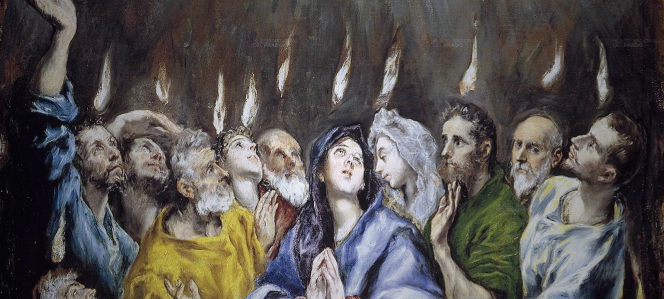
Something took up residence in the apostles and became part of them. Acts described this force as the Holy Spirit that descended from heaven like a terrifying wind, filled the house and then rested on each believer.

The indwelling of the Holy Spirit on Pentecost reminds us how indispensable the Spirit is for our faith and salvation. Pentecost reminds us that we are not saved by doctrinal orthodoxy or our determination to follow scrupulously rules and commandments. We are saved by the acts of God.

The indwelling Holy Spirit bestows on us the virtues of faith, hope and love from which all other Christian virtues and actions follow. As it did in the first believers, the Spirit produces in us a particular kind of fruit. St. Paul listed the fruit as love, joy, peace, patience, kindness, goodness, faithfulness, gentleness and self-control. (Gal 5:22-23) In short, the Holy Spirit dwelling within the believer produces the character of Jesus.

On Pentecost, the Trinity imparted a gracious gift that produced in each believer the character of Jesus. Frightened men and women who hid from authorities no longer feared dungeon and death. They faced it because the character of Jesus now dwelt within them. The character of Jesus dwelt within them.

From indwelling to involvement. Acts teaches us that on Pentecost, the believers did not remain in the place where the Holy Spirit descended upon them. Rather, as soon as they received the Holy Spirit, they began to witness.

Following Jesus’ last command – You will receive power when the Holy Spirit has come upon you, and you will be my witnesses in Jerusalem and in all Judea and Samaria, and to the end of the earth – their witnessing flowed naturally. (Acts 1:18)

Their witnessing began in Jerusalem, and quickly reached Italy, Greece, Turkey, Iran, Iraq, Saudi Arabia, Egypt and Libya – the cities and regions mentioned in verses 9 and 10. The Gospel spread like wildfire because Christians – filled with the Holy Spirit – cut people to the heart with words like repent and be baptized in the name of Jesus Christ for the forgiveness of your sins, and you will receive the gift of the Holy Spirit; and save yourselves from this crooked generation. (Acts 2:37-40)

Christians spoke like that because they were intoxicated with the power of the Holy Spirit. The power of the Spirit brought about their ability to speak other languages, but it was clear that the church was not building a language institute but a body of believers sent to every nation on earth. Christians involved in the world resulted in 3,000 baptisms on Pentecost.

Folks, I have preached and pastored since 1987. I participated in gatherings of a million Christians, and several years ago I traveled to Ecuador where I witnessed the phenomenal growth of Evangelical Church, but I never heard of a baptism of 3,000 people. This occurred because Christians intoxicated with the Holy Spirit were involved in the world.

Christians intoxicated with the Holy Spirit involved in the world. … Folks, are you intoxicated with the Holy Spirit? Does the Holy Spirit dwell within you to the degree that you speak and act like you drank too much? Are you involved in the world?

Apart from voting, most Christians avoid involvement in the world. We excuse ourselves because we dislike politics and despise dirty tricks. Yet, we see that Jesus involved himself in the lives of thousands of people by teaching God’s Word, forgiving their sins, healing their infirmities and quenching their hunger. In short, Jesus challenged the establishment.

Jon Kuhrt, a Christian involved with London’s homeless recently wrote, “We have no choice about being political because if we choose not to engage then it is a vote for the status quo … Christians [must] be involved because we believe in a God who cares passionately about his world and his creation, and consequently how it is run. The Bible is hugely political – in that it is about how God wants people to behave and act towards him, and towards each other. This involves economics and law because these are tools that need to be used to build justice.

As believers in God, we have much to bring to politics – a deeper commitment to justice and compassion which throughout history has made a difference in the political sphere through people like William Wilberforce, Martin Luther King, Desmond Tutu and many others.”

Kuhrt goes on to say, “Be involved in your local community – what issues do local people care about? How can you help make a noise about key issues local to you?  How does your church or youth group connect with issues of justice either locally or globally?  How can you build knowledge of what is going on and get passionate with others about making a stand?

Join the Christian group of the party that you believe in and be an advocate for Jesus’ politics within it.  Be brave and courageous – don’t just follow the crowd, but be willing to ask the difficult questions.” Be involved, but be indifferent.

Hence, my last point, indifference. Indifference does not contradict my previous point. By indifference I do not mean apathy or a “who cares” or “whatever” attitude. On the contrary, holy indifference means total openness to God’s will in one’s life. In other words, whatever God wills for me, I will strive with all my heart, mind and soul to conform to His will. I will not prefer health to sickness, riches to poverty, honor to dishonor, a long life to a short one.

So, how did Jesus expect His disciples to attain holy indifference? How did the first Christians achieve acceptance of God’s will? How did sentenced Christians bring glory to Christ? Through a constant, dynamic prayer life which led them to total confidence in God and a willingness to give themselves wholly to the Trinity.

They were indifferent because they knew God directed them. Their love for Father, Son and Spirit was so deep that all obstacles between God and themselves were removed to the point that they knew how to use things properly, for example, talent, money, property or politics to glorify God. They were able to do so because they recognized that all things came from God, and that all people were from God. Hence, the first Christians not only withstood their enemies’ insults about intoxication, but also welcomed them if they brought glory to Christ and His Gospel.

Friends, four-eyes is not the worst insult people will hurl at you. Intoxication is not the worst accusation people will make. A Christian intoxicated with the indwelling Holy Spirit involved in the world who employs holy indifference will make all the difference needed to bring about God’s Kingdom because of what Father, Son and Spirit have done. Allow this God to work in you, and know that when He does, the peace of God that surpasses all understanding will keep your hearts and minds in Christ Jesus. Amen.