Friday, December 2, 2022

ADVENT COLORS


What’s your favorite color? My wife’s favorite color is blue. She looks good in blue. She was wearing a blue dress when I first met her. Blue, red and yellow are called primary colors. You can mix them together to make other colors.

The Bible mentions blue almost 50 times. Churches use blue during Advent. Blue is the color of the sky, which reminds us of hope. Our Christian faith rests on the hope that Christ, who came in history as a baby and grew to be a man, will return from that blue sky into which He went. Before Christ returns, Advent gives us time to prepare for His return and for Christmas through prayer and listening to God’s Word. Blue makes us feel like doing that.

Next week, I will talk about pink, but for today, let’s stick to blue. Advent wreathes have blue candles. Last week, we lit one candle. Today, we lit two candles because today is the Second Sunday of Advent.

The first Advent candle is known as the prophecy candle or candle of hope. The second is called the Bethlehem candle or the candle of peace. And the fourth is called the angel candle or the candle of love. Hope, peace and love.

As we draw nearer to Christmas, we’re going to be so busy and so excited, and the candles of the Advent wreathe and the daily prayers in our Advent calendars will keep our minds fixed on God – Father, Son and Holy Spirit – so that we remember the true reason for celebrating Christmas: Jesus.

Jesus not only gives us hope, peace and love, but is all three. As you go through your days for the next few weeks, focus on Jesus. When you think you or someone else needs a little hope, peace and love, think of the color blue and pray.

Let us pray. Heavenly Father, from whom all fatherhood in heaven and earth is named: Bless all children, and give their fathers and mothers the spirit of wisdom and love, so that the homes in which they grow up may be to them an image of Your Kingdom, and the care of their parents a likeness of Your love. We pray in the Name of the Father and the Son and the Holy Spirit. Amen.

Thursday, December 1, 2022

Stump Growth


God’s grace, peace and mercy be with you. My sermon today is entitled Stump Growth, and my focus is Isaiah (chapter 11, with a special emphasis on verse 1: “A shoot will come up from the stump of Jesse; from his roots a Branch will bear fruit.”). Let us pray. Heavenly Father, the psalmist wrote, “I rejoiced when they said to me, ‘Let us go to the house of the Lord.’” Now that our feet are within your gates, we rejoice to hear your Word. As we listen, may your Spirit enlighten our minds and move our hearts to love deeply as Jesus loved. This we pray to you, Most Holy Trinity. Amen.

Have you ever coppiced? Some of us have coppiced, but are afraid to admit it. People who know how to coppice can make a good living at it. Before you get the wrong idea – to coppice means to cut back in order to regrow.

A traditional method of woodland management, coppicing enables new growth from the stump or roots if cut down. You cut the tree stems to about ground level so that new shoots can grow. Then the coppiced tree is ready to be harvested, and the cycle begins again.

Willow trees are the most popular because of their rapid regeneration. When I lived in Oklahoma, I had a lot of unwanted coppiced trees in my back yard. Some of you may have them here. You cut the tree down to a stump, and shoots sprout from the roots. If you want to get rid of unwanted coppiced trees, drill holes in the stump, pour in potassium nitrate and burn them, or call a professional landscaper.

Stump growth was quite familiar to Israelites. Therefore, it is quite logical that when prophesying about the Messiah that Isaiah’s prophecy would use a familiar image. Shoots sprout from stumps and roots bear fruit. However, before examining the prophet’s message, we explore how John the Baptist practiced coppicing along the Jordan River 700 years later.

John called people to “Repent, for the kingdom of heaven is near.” He echoed Isaiah’s words: “Prepare the way for the Lord.” Repentant sinners prepared through baptism. Those too proud for repentance and baptism faced the ax and fire. As the homeowner of wooded property, I know exactly the meaning of John’s words, “The ax is already at the root of the trees, and every tree that does not produce good fruit will be cut down and thrown into the fire.” Unlike John, I use a chainsaw before I throw dead trees and rotten stumps into the fire.

Coppicing or cutting down makes room for new growth in forest or field, in ministry or the military. Being cut down or just being cut down to size is humbling and even humiliating. The problem of the Pharisees and Sadducees chastised by John was that they lacked humility, and would not repent. John cut down unrepentant sinners who produced no fruit. His message was much like Isaiah who cried, “The eyes of the arrogant will be humbled and human pride brought low; the Lord alone will be exalted.”

Like John, Isaiah called people to prepare for the Day of the Lord. And so, we return to Isaiah to see how stump growth is related to messianic prophecy. When God called Isaiah to be a prophet, an angel flew to him with a live coal from the altar. The angel touched the prophet’s mouth and said, “See, this has touched your lips; your guilt is taken away and your sin atoned for.” Isaiah then heard the voice of God reveal how His people would be captured and His land wasted. Yet, God promised, “But as the terebinth and oak leave stumps when they are cut down, so the holy seed will be the stump in the land.”

The holy seed will be the stump in the land. … Isaiah maintains this divinely inspired stump growth image throughout his preaching. In today’s opening verse, he states, “A shoot will come up from the stump of Jesse; from his roots a Branch will bear fruit.” Jesse, the father of King David, is an ancestor of Jesus. “Son of David” is a biblical term that refers to the Messiah. Thus, the shoot that grows out of the stump of Jesse is the Lord Jesus.

Isaiah prophesied the Spirit will rest on the Christ, the Messiah. He then describes some aspects of this Promised Messiah. The Spirit will endow Him with wisdom and power, and other gifts; and the poor and needy, He will judge with righteousness. …

You say, “That’s all quite nice, but what does a 2,700 year-old messianic prophecy have to do with Christian living in 21st century America? What message do Isaiah and John leave for us today?” Two words: WAKE UP!!!

Following Christ today is more arduous than clearing a wooded lot, more humbling than basic training in God’s Army. For the mature Christian, following Christ means humiliation, death and new growth. In other words, Christian discipleship involves constant wakeup calls.

An example. 17 years ago this month, my friend, Doctor William Katz, Clinical Director of Echocardiography at the University of Pittsburgh Medical Center’s Heart and Vascular Institute, informed me that my mother had between two months and two years to live. At the time, I was serving as a pastor and hospital chaplain in Eureka, California. I asked Bill, “Do you think I should come back?” His one-sentence wakeup call was, “If it were my mother, I would.” Sometimes, following Christ involves not only moving, but also moving out of your comfort zone. Moving from Northwestern California to Southwestern Pennsylvania changed my lifestyle and added new responsibilities. Being mom’s primary caregiver changed me, but left me with no regrets.

A more compelling example is from Congressman Mike Doyle of Pennsylvania. I met Mike, a member of Word of God Church in Swissvale, when I served as a pastor there in the mid-90’s. One Sunday morning when he spoke to our men’s group, a member of the church asked Mike how his life changed since he was elected to Congress. Mike response was this.

“As a congressman, you receive a lot of invitations to speak to people. In the first six months, I accepted every request. During the week, I lived and worked in Washington. On weekends, I spoke to groups throughout the district. Then, one Saturday morning I was sitting at the kitchen table with my wife, drinking coffee and reading the paper, when she asked, “How long are you going to do this congress thing?” Putting down the paper, I responded, “What do you mean?” My wife said, “I want to know how long you’re going to do this because I want to know when I’m going to get my husband back, when the kids will get their father back, and when we will be a family again.”

Mike said, “It was like getting smacked between the eyes with a 2x4.” He continued. “I informed my staff that I would take no more Saturday requests.” Mike, who will retire from office in January 2023, who attended church faithfully and participated in a congressional prayer group, learned that the mature Christian sometimes needs a humble smack between the eyes with the proverbial 2x4 in order to make necessary changes to save his marriage and family, to be coppiced in order to enable new growth.

Advent is that sobering time when Christians eagerly anticipate the coming of Christ – as an infant on December 25th and as glorious Lord and Judge on a date yet unknown. As that Day of the Lord nears, we have to ask ourselves three questions. First, am I prepared to repent or cut back in order to bear fruit? As I prepare for Christmas, what activities in my life do I need to cut to regenerate new growth? If the Holy Spirit could coppice my life, how would that benefit the people closest to me? How would basic training in the Lord’s army humble me and make a better Christian out of me? Instead of watching television or online videos, can I spend more time pondering God’s Word? Am I willing to share more time with my spouse and family and less time on social media?

Second, am I willing to forgive because I have been forgiven? As we receive invitations to holiday parties and family dinners, is there someone with whom I need to make amends? You know that person – the one who owes you rent because he or she occupies so much time in your head and even causes you to sin in thought. Am I as arrogant as a Pharisee on Jordan’s Bank that I need not reconcile? Who have I not forgiven as the Lord has forgiven me?

Finally, do I love with abandon – because God will never abandon us? Do I express my excitement like a puppy? Whenever you come home from work, maybe the spouse or kids do not get excited and run to greet you, but the family dog does and makes you feel like a million bucks because they live totally in the present. … God lives totally in the present. Every time God sees you, he gets excited and runs like some old fool to greet you with hugs and kisses (Luke 15:20). Do I love like that? Do I love with abandon? If not, perhaps the biggest change I can make is to love God and neighbor with abandon knowing that God will never abandon me. Friends, God will never abandon us, and as we await the Day of the Lord, may the peace of God that surpasses all understanding, keep your hearts and minds in Christ Jesus. Amen.[*]


[*] For additional notes, see https://cwynar.blogspot.com/2013/12/stump-growth.html

Saturday, November 26, 2022

ADVENT 1


Do you like to wait? If you don’t, you’re in good company. Most people do not like to wait, but we all wait for the bus, the end of class, for the doctor, in line, in traffic and for events to begin. Most of the time, waiting is boring, but sometimes it’s exciting.

It’s exciting to wait for a party or big game to begin. It’s exciting to wait for a new puppy or kitten to arrive or for a baby brother or sister to come home from the hospital.

Advent is an exciting time to wait. We wait for Christmas when we celebrate the birth of Jesus. But we all know that Jesus was born, lived, died on the Cross and rose from the grave. We all know that Jesus will come again – and that’s what we’re waiting for – His return!

So, how will you wait for Jesus? Well, maybe your family has an Advent wreathe at home. Each day before dinner, you can light a candle and listen to mom or dad read the Bible and pray before you eat. Maybe your family has an Advent calendar with a different Bible passage and small gift each day.

Those are some ideas on how to wait for Christmas. How do we wait for Jesus to return in glory?

Martin Luther taught people that every day they should remember their baptism as they begin to pray. We make the Sign of the Cross and say, “In the name of the Father, and of the Son, and of the Holy Spirit. Amen.” We then say the Apostles Creed and the Lord’s Prayer. He also included this prayer that we can say each morning.

I thank you, my heavenly Father, through Jesus Christ, Your dear Son, that You have kept me this night from all harm and danger; and I pray that You would keep me this day also from sin and every evil, that all my doings and life may please You. For into Your hands I commend myself, my body and soul, and all things. Let Your holy angel be with me, that the evil foe may have no power over me. Amen.

Say that every morning as you wait for Jesus to come at Christmas and in His glory.

Friday, November 25, 2022

Day and Place


God’s grace, peace and mercy be with you. My sermon today is entitled Day and Place, and my focus is our reading from Isaiah (2:1-5). Let us pray. Heavenly Father, the psalmist wrote, “I rejoiced when they said to me, ‘Let us go to the house of the Lord.’” Now that we are within your gates, we rejoice to hear your Word. As we listen, may your Spirit enlighten our minds and move our hearts to love deeply as Jesus loved. This we pray to you, Most Holy Trinity. Amen.

Day. I can use the word day in many different ways. As a greeting, I can say, “Good day.” As a question, I ask, “What day is it?” I can sing, “Day by Day.” I can refer to a specific day – September 11, 2001; July 4, 1776; or our anniversary – August 7, 2010. Day can also refer to a span of time, such as the good old days, or an indefinite period of time, like endless days of work or school. The word’s origin is Germanic, and is pronounced tag. When we were in Germany this past summer, I certainly felt confident when I greeted someone with the phrase Guten tag.

All of this talk about day stems from both our Gospel (Matthew 24:36-44) and our first reading (Isaiah 2:1-5). In the Gospel, Jesus speaks apocalyptically to his disciples following his departure from the Temple about the end of the age and the coming of the Son of Man. He concludes his lesson with the words, “Therefore you also must be ready, for the Son of Man is coming at an hour you do not expect.”

In Isaiah, the backdrop is the relationship between the Assyrian Empire and Judah, the southern kingdom. That looming threat is important to keep in mind when reading Isaiah. It is similar to reading literature out of Eastern Europe during the days of the Soviet occupation. The threat of annihilation colored everything said or done. Yet, even with that threat, Isaiah was not deterred about prophesying many things including the vision of “the latter or last days,” or “the day of the Lord.”

The Day of the Lord is the undated future, neither necessarily near nor far. The Day of the Lord, according to the prophets, is when God would bring judgment and a victory that would lead to peace. Hosea saw this day as the consummation and enjoyment of God’s rule (Hosea 3:5), and all the other prophets insisted on the certainty of what God would do and present the necessity of being ready.

Later, Isaiah would describe this day as terror, the pit and the snare (24:17-23). Joel described it as a day of warnings with the sun darked and the moon turned into blood (2:30-32). Malachi, as we heard two weeks ago, predicted that Elijah would come before this day (4:5-6). Such predictions of this day shaped the image of what Jesus said in chapter 24.

There have been many predictions when this day would occur, and all of them have one thing in common. They have all been wrong. That leads me to wonder why Jesus in his divinity withheld this date from his disciples. An ancient theologian answered this by comparing it to not knowing the date of your death writing that God withholds this so that I might always do good since I can expect to die at any moment. “The date of Christ’s second advent is withheld from the world for the same reason, namely, so that every generation might live in the expectation of Christ’s return.”[1] I will return to day later, but for now place.

Place. The word is used as a verb and a noun. Used as a verb, I can place items in different spots, such as my furniture or books. As a noun, I can refer to place as an indefinite or a particular spot. Pittsburgh can be an indefinite place for southwestern Pennsylvania. I don’t live in Pittsburgh, but when travelling, I use it to refer to where I live. The Danube River was the indefinite place where we vacationed this summer. I did not stay only in one spot on the Danube, but use it to refer to the many sites I visited this past year.

When I use the word place to refer to a particular spot, I can say that I stand in a particular place – the pulpit – when I preach. The pulpit is a very small place compared to Pittsburgh geographically, but spiritually greater. Place comes to us from the Latin words, placea meaning place or spot, and platea meaning courtyard broad way or avenue. The When you travel to Europe it’s good to know that Italians use the word piazza; the Spaniards, plaza; and the Germans platz.

Buildings are places used for different purposes and after time repurposed. St. John the Baptist Catholic Church in Lawrenceville (Pittsburgh) once served as a place of worship, but now is a place to eat and drink. A nearby synagogue now serves as a dialysis clinic. A gas station in Ambridge has been transformed into a coffee shop and café. Many schools have been converted into apartment buildings. The place Isaiah speaks of in chapter two is a fascinating place.

In what places were Isaiah and Jesus? We understand from the opening verses of Isaiah 1, that the prophet is in Jerusalem, specifically on Mount Zion. When Mount Zion is referenced, think of a neighborhood, like Capitol Hill in Washington, or College Hill in Beaver Falls. His prophecy is about the mountain of the house of the Lord. Mountains were homes of the gods, and while Zion was not the highest, it is still the mountain where the one true God was to be found. This is the place where God revealed his ways to humans. Here, people came to learn how to live. The outcome of coming to learn this is that nations will live in harmony.

As I said a moment ago, you need to keep in mind the backdrop of the Assyrian Empire and Judah. In this place, Mount Zion, Isaiah proclaimed this poem. The interesting fact about this poem (vv 2-5) is that it is the same poem found in the Prophet Micah (4:1-4), meaning that it was a popular poem known throughout Judah and Israel. It was written as a challenge to the people to face up to what they were singing: If others are to say, “Come, let us go up to the mountain of the Lord,” Judah must heed the call to “walk in the light of the Lord.”

It reminds me of all the beautiful hymns we treasure, and the confidence we must have when we sing “A Mighty Fortress is Our God,” particularly the words at the ends of the stanzas. We sing, God’s only Son, adored. He holds the field victorious. God’s judgment must prevail! One little word subdues him. They cannot win the day. The Kingdom’s ours forever! When I sing those words, I feel there is no opponent of God that I will ever fear. Kudos to Martin Luther for writing words that inspire us 500 years later.

Isaiah’s poem is also reminiscent of Psalm 122, which I reference whenever I open my sermon. That a stream of people would flow to the highest point is against the laws of nature, but the point is that the highest point has a supernatural magnetism. The peoples, that is, people from all races, nations, cultures and ways of life, will come voluntarily to acknowledge the God of Jacob as the God of all nations. People will adopt the Law of Israel’s God.

Verse 4 tells us that the reduction of arms is a hopeful cause of peace. For Isaiah this is a divine reordering of the world which will happen as a consequence of all people recognizing the one true God and forsaking nationalism. The choice of turning weapons of violence and war into agricultural instruments is reflective of Eden. Our return to Eden means that people will be right with God again. The curse removed, and the serpent defeated means that we will have the ideal environment, the ideal place.

In a word, Israel’s mission from God was to walk in the light of His ways so that even the Gentiles seek out the one true God. With the coming of Jesus Christ and the preaching of the Apostles, Gentiles sought the one true God and His ways, His Law and His Gospel. So, having accepted the Gospel, what must we do? As we begin this Season of Advent, how are we prepared to meet Christ in His second coming?

Today, we lit the first candle on the Advent wreath. Over the next three Sundays, the light coming from that wreath will grow stronger as one more candle is lit. It will be more attractive, and will draw us more deeply to it, but the wreath is a symbol unlike the Primary Symbol that is Christ the Lord God, to whom we ae attracted even more strongly.

The whole point of Isaiah’s prophesying is to draw people closer to God. The whole point of Jesus’ ministry is to draw people closer to the Father. The whole point of our existence is to know, love and serve God our Father through His Son as His Church, His people. For that to happen, our hearts must be touched. With that, let me tell you a story.

 On Thursday, November 10, 2022, Scott Rodenbeck and I attended the 35th Annual Night for Life Benefit Banquet benefitting Choices Pregnancy Services.[2] The Guest Speaker was Dr. Anthony Levatino. There is a link to Dr. Levatino’s story in the footnotes, and I encourage you to read it and others.[3]

Dr. Levatino spoke of his story from providing 1,200 abortions to why doctors perform them to how the medical establishment views the prolife community, and how he was viewed by his colleagues once he embraced the community. I won’t go into all the details of how doctors perform abortions. That too is in the link. What struck me was his story of how the prayers of one of his patients, Susan, impacted his life. His comment that when a person says to you that has a message from God that Jesus loves you very much and he wants you to stop performing abortions, and that she has been praying for you every day, you tend to think that person is looney.

Friends, today in this place I ask you to consider yourself looney. Respectable people have worse opinions about me, so being looney doesn’t hurt. Today, Dr. Levatino tells Christians to find out who is providing abortions – the names of the doctors, administrators, nurses and others who perform abortions, and pray for them and their family members every day as Susan did for Dr. Levatino. Why? Because Jesus loves them and wants them to stop taking the lives of the little children Jesus welcomed.

Dr. Levatino told us that doctors who provide abortions do it for two reasons; they have been convinced by everyone that they are serving the woman, the patient before them, which every doctor does. The other is because performing abortions is lucrative. Abortion allows doctors to buy a lot of nice things when they accept the money of a patient who tells them to take the life of their son or daughter. These people need prayers on their hearts. They need your prayers so that the loving and merciful power of God can transform their hearts.

Today in this place, and every day in whatever place you find yourself, the power of prayer transforms hearts. Some hearts are conflicted while others are hardened. So, it may take you longer than seven years to see someone’s heart and life transformed, but remember: It’s not what you do, it is the power of God at work through you. Friends, God needs you and me to be his agents, his angels, his messengers, his witnesses. When we open ourselves to what God wants, we experience the peace of God which is beyond all understanding keeping our hearts and minds in Christ Jesus. Amen.


[1] “Incomplete Work on Matthew,” Ancient Christian Commentary on Scripture: New Testament Ib, Matthew 14-28. Edited by Manlio Simonetti; General Editor, Thomas C. Oden. Downers Grove IL: InterVarsity Press (2002), p. 210.

Monday, November 21, 2022

History, Healing and a Happier Thanksgiving


God’s grace, peace and mercy be with you. My sermon is entitled History, Healing and a Happier Thanksgiving, and my focus is our Gospel (Luke 17:11-19). Let us pray. Heavenly Father, the psalmist wrote, “I rejoiced when they said to me, ‘Let us go to the house of the Lord.’” Now that our feet are within your gates, we rejoice to hear your Word. As we listen, may your Spirit enlighten our minds and move our hearts to love deeply as Jesus loved. This we pray to you, Most Holy Trinity. Amen.

Having worked four years as Director of Development at Berkeley Food and Housing Project in California, one of the state’s largest homeless service providers, I can tell you that not everybody spends the fourth Thursday in November with family. Thousands of Americans eat Thanksgiving dinner at soup kitchens, homeless shelters, church basements and other fine establishments. Pilgrims from every side of the political pendulum serve these down-and-out diners. That said, today, we put aside politics to look at Thanksgiving’s history, a leper’s healing and how we can enjoy a happier Thanksgiving.

First, Thanksgiving’s history. For some, Thanksgiving commemorates a heritage of false memory. Internet myths of Thanksgiving range from fundamentalists’ invention of a fake 1623 Thanksgiving Proclamation – to prove that God was being thanked and not the Indians – to Libertarians, who used the same fake proclamation to claim that “the real reason for Thanksgiving is that Socialism does not work.”[1]

Puritan Pilgrims celebrated the first Thanksgiving after their first harvest in the New World in 1621. The feast lasted 3 days. 90 Native Americans and 53 Pilgrims attended. The Pilgrims were accustomed to regularly celebrating thanksgivings – days of prayer thanking God for blessings such as military victory or the end of a drought.

Thanksgiving became an official Federal holiday in 1863, when, during the Civil War, President Abraham Lincoln proclaimed the last Thursday in November a national day of “Thanksgiving and Praise to our Father … in the Heavens.”

As a faith community, we celebrate thanksgiving when we gather for the Lord’s Supper. Eucharist means we give thanks because the gift is nothing less than forgiveness of sins for which we can never atone. We give thanks because we have nothing else to give but gratitude.[2]

Where faith has genuinely received such gracious gifts, it cannot help but be eucharistic or thankful to God. Such thanksgiving will show up in worship, but also in daily life – an attitude of gratitude revealed in how we live with those around us.

Now, let’s take that attitude of gratitude and turn to the Gospel where health and salvation go together like turkey and stuffing.

To the 10 lepers requesting that he have mercy on them, Jesus replied, “Go and show yourselves to the priests.” Jesus was following the Law, specifically Leviticus, chapter 14. Was the Samaritan, who lived outside the requirement of Judaism, included in the command to go to a priest? Moreover, why did Jesus reproach the other nine for following the Law and his command? Furthermore, why did Jesus say, “Your faith has made you well,” when all were cleansed?[3]

Questions demand further exploration because the Gospel of Luke is richer than pumpkin pie and Whipped Cream. Note that Luke opens this story by telling us that on his way to Jerusalem, Jesus was passing between Samaria and Galilee. Mentioning Samaria is significant, since only the Samaritan responded with grateful faith and praise. At first, the Samaritans rejected Jesus’ disciples because he was going to Jerusalem. When the disciples wanted to call fire down from heaven to destroy them, Jesus would not allow it. In fact, a Samaritan showed the Jews how to be a good neighbor according to the law.[4] And now, by contrast with nine others, a Samaritan embodies the conditions of salvation.

For salvation actually to be realized, the healed person must respond in faith, a gift that is open to all. The grateful Samaritan reminds us that salvation is not limited to the Jews, but is universally offered to all people.

Like the nine lepers who did not return to praise God and Jesus, the Pharisees failed to recognize that the kingdom of God was already in their midst. It was manifested in Jesus’ healing, but they looked elsewhere for it. Without faith, miracles are opaque. If the other nine and the Pharisees were not blind, they certainly suffered from glaucoma.

Finally, how to enjoy a happier Thanksgiving. … How do I recognize the kingdom of God is in our midst? Through a recent healing? When I see down-and-out diners served by well-heeled waiters? By confessing my sins and a pastor’s absolution? Perhaps when I showed mercy to another sinner, as Jesus showed mercy to the lepers? Folks, when we recognize God is truly in our midst, and praise Him for that, our thanksgiving feast around the table of our homes and around the table of the Lord will be truly happy.

Notice, Jesus instructs the grateful leper, “Rise and go on your way.” After our final hymn, as you rise and go on your way, journey not only to your homes and dinner destinations, but also with Jesus. Let the Holy Spirit take you where God wants you – California, Oklahoma, Illinois or overseas. For when you go with God, the peace of God that surpasses all understanding, will keep your hearts and minds in Christ Jesus. Amen.


[1] http://historynewsnetwork.org/article/15002

[2] Larry Vogel, Toward a Theology of Worship That Is Pastoral and Sacramental. Model Theological Conference on Worship January 11, 2010, 20

[3] Craddock, 202f.

[4] LaVerdiere, 215

Friday, November 18, 2022

TORA TORA TORA


Have you ever heard somebody repeat the same phrase 3 times in a row? If you repeat the same word 3 times in a row, it is very, very important. If you say, “Help me! Help me! Help me!”, we all know that you need help right now. Pilots use the phrase, “Mayday! Mayday! Mayday!” to tell others that they are in trouble.

In our Gospel today, Luke repeats something that happened to Jesus as he was hanging on the Cross. After He said, “Father, forgive them, for they know not what they do,” people mocked Jesus three times. First, the rulers mocked Jesus; then the soldiers mocked Him; and finally, one of the criminals hanging next to Jesus, mocked Him.

What this tells us is that these people delighted in mocking Jesus. You know who else mocked Jesus with great delight? Saul of Tarsus. Saul persecuted Christians and was present when Stephen was stoned to death. He heard the same words Jesus said, “Father, forgive them, for they know not what they do.”

Here's another phrase that was repeated three times by a pilot 81 years ago. Mitsuo Fuchida was the pilot who led the Japanese attack on the US Navy Base Pearl Harbor. After the surprise success attack was successful, he said “tora tora tora.” It was a code phrase claiming victory over the enemy.

Years later, Fuchida became a Christian, and even though he killed many innocent people on December 7, 1941, he felt deep shame and guilt for what he did, and accepted Christ’s forgiveness, like the prisoner who asked Jesus to remember him in his kingdom, and like Saul of Tarsus, who then became Paul. St. Paul and Mitsuo Fuchida both became Christ’s apostles and spread the Gospel of Jesus, the Good News that on the Cross our sins are forgiven. Your sins are forgiven. With that we pray.

Let us pray. Heavenly Father, from whom all fatherhood in heaven and earth is named: Bless all children, and give their fathers and mothers the spirit of wisdom and love, so that the homes in which they grow up may be to them an image of Your Kingdom, and the care of their parents a likeness of Your love. We pray in the Name of the Father and the Son and the Holy Spirit. Amen.

Thursday, November 17, 2022

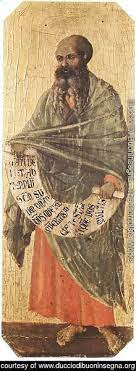
Malachi's Message


God’s grace, peace and mercy be with you. My sermon today is entitled Messenger, Message and Meaning and my focus is Malachi (3:13-18). Let us pray. Heavenly Father, the psalmist wrote, “I rejoiced when they said to me, ‘Let us go to the house of the Lord.’” Now that we are within your gates, we rejoice to hear your Word. As we listen, may your Spirit enlighten our minds and move our hearts to love deeply as Jesus loved. This we pray to you, Most Holy Trinity. Amen.

Periodically when our granddaughter would stay with us, we would take her to the playground at Brady’s Run Park where she would meet other children. After an hour of playing, we would gather Emma, leave and ask her if she had a good time.  She would tell us that she did and that she met a new friend. We would ask, “What was her name?” She would reply, “I don’t know, but she …” This was followed by all the remembered information – what school she attends, how old she is, her father’s occupation and so on. I mention that because we’re not 100% sure of the real name of God’s messenger in today’s Old Testament reading.

Malachi, the last book in the collection of the twelve Minor Prophets and the Old Testament, is one of those people in the Bible about which we know little. Malachi may not even be the prophet’s name, because it is also the word for angel or messenger. In the opening verse, we read, “The oracle of the word of the Lord to Israel by Malachi.” Then in 3:1, we read, “Behold, I will send my messenger,” which is the same word as Malachi. We have many proper names that are nouns, such as Liberty, Hope, Prudence, Bob, Cooper, Mason, Deacon and so on. For this and several other reasons, we accept that the messenger’s name is Malachi.

We know nothing of his life, but learn something of the kind of person Malachi was. Despite his attacks on priests, he was favorable to Levitical priesthood, and insisted on the people’s obligation to contribute to the expenses of the Temple and support of the personnel.[1]

He was also a person concerned about the welfare of others: the wife who suffered rejection and the people of Judah who wondered about God’s love for them.[2] He also supported the defenseless and was sure that their oppressors would receive from God what they deserved. He understood God’s honor and the transcendence which enables God to enforce his will wherever he wishes. In Malachi, we find new hope, for his use of language is close to that of Haggai and Zechariah, and like them, shared an enthusiastic expectation about the rebuilding of the Temple.

That is about all we know about the messenger. On to my second point: What was Malachi’s message for his people? His message has six distinct sections, each in the form of a question-and-answer discussion. This unusual discussion technique allowed Malachi to defend the justice of God to a community that began to doubt that justice because its eschatological (end of the world) expectations were still unfulfilled. Malachi called for faithfulness to God’s covenant, and emphasized the necessity of proper worship, condemned divorce, and announced that the day of judgment is near. Faithfulness to ritual and moral responsibilities would be rewarded, and unfaithfulness would bring a curse.

In our passage today, we read of the need to serve God, but the problem is the people’s cynicism in the face of the prosperity of evildoers. They grumble and complain that those who are prospering are not the ones who adhere to God’s wishes. Of course, this is not the first time such grumbling occurred. In Job 21, we read, “What is the Almighty, that we should serve him? And what profit do we get if we pray to him?” (v. 21). Isaiah prophesied, “‘Why have we fasted, and you see it not? Why have we humbled ourselves, and you take no knowledge of it?’ Behold, in the day of your fast you seek your own pleasure, and oppress all your workers” (58:3).

In v. 16, we read of a book of remembrance. Given that we are at the end of the church year, it’s a fitting image to ponder. The image of a written record of the names of the just or of those who are destined for life is found in Exodus, Psalm 69, Isaiah, Daniel and Revelation.[3] Perhaps like Moses decrying the sin of his people or David pleading to God not only to save him but also to punish God’s enemies, we too who fear God should think of Him in our daily endeavors that we are remembered in His book.

As God’s special or treasured possession, do you pray that you and yours are spared from punishment? I ask that because in v. 17, the phrase is applied to Israel as God’s elect. Before Moses received the Ten Commandments, God spoke, “Now therefore, if you will indeed obey my voice and keep my covenant, you shall be my treasured possession among all peoples, for all the earth is mine; and you shall be to me a kingdom of priests and a holy nation.’ These are the words that you shall speak to the people of Israel” (Exodus 19:5-6).[4] The idea is that God’s most prized possession is that group of people who fear him and follow him. Notice that Malachi’s message does not extend to all of Israel, but to that small group which distinguished itself from all the wicked within Israel. And so, I ask you that when you do pray that you are spared from divine wrath, how will God recognize you from all the wicked, sinful people who surround you? And so, Malachi’s message can be summarized in one question: Do I serve God or not?

Let’s move to my third point, meaning. What does this message from 2500 years ago from an obscure messenger have to do with us? What is the meaning for our lives as Church? Do we ever doubt God’s promises? Questioning God’s promise is how the devil tempted Cain and many others. And while Job did not sin, he must have wondered why the arrogant were blessed while the faithful walked around like mourners all the time. Why do evildoers get away with it? Why do the wicked test God without getting struck by lightning?

Malachi’s people could ask that question because they were looking at their relationship with God as if it were a business contract. They thought they could trade their obedience for his blessing. But God does not see his grace as something to be earned by his people’s compliance. God wants a relationship of love and mutual self-giving. So, he reminds them just how much they mean to him and how much he wants to do for them.

When we reflect on the phrase “my treasured possession,” keep in mind that you are not some random person whom God has chosen on a whim to love. God created you out of love, and formed you in his own image. Just as a pearl cannot cease to be a pearl, that is, change what it is, neither can you cease to be precious in God’s eyes.

When Malachi prophesied, “I will spare them as a man spares his son who serves him,” he meant that God loves you as his own and has made you his son or daughter. Like any good earthly father, your heavenly Father’s love for you is not based on your performance. He loves you even when you fail. He loves you even when you sin! And he is always ready to welcome you back when you return to him.

Later, we read, “the sun of righteousness shall rise with healing in its wings,” we take it to mean that God promised the Israelites that they would eventually see justice done. That promise is for you too. Someday, if not in this life, then in the life to come, you will be healed of every injustice. There will be no more pain or sorrow, no more tragedy. All will be made right.

So, what can we count on in this life? We cannot count on immediate solutions to our problems and questions. But we can count on God’s love and his constant desire to draw us closer to him. As we hold fast to him, we will receive his love – the greatest “profit” of all.

Friends, hold fast to God’s promises, and as you do, may the peace of God which is beyond all understanding keep your hearts and minds in Christ Jesus. Amen.


[1] Aelred Cody, OSB, “Haggai, Zechariah, Malachi,” in The New Jerome Biblical Commentary …. P. 359. See 1:6-2:4; 2:4-7.

[2] 2:14-16; 1:2-5.

[3] Exodus 32:32-33, Psalm 69:28; Isaiah 4:3; Daniel 12:1; and Revelation 20:12, 15; 21:27

[4] See also Deuteronomy 7:6; 14:2; 26:18; Psalm 135:4;