Friday, April 15, 2022

The Last Word


God’s grace, peace and mercy be with you. … My sermon is entitled The Last Word and is based on the Seven Last Words of Jesus. Let us pray. Heavenly Father, the psalmist wrote, “I rejoiced when they said to me, ‘Let us go to the house of the Lord.’” Now that our feet are within your gates, we rejoice to hear your Word. As we listen, may your Spirit enlighten our minds and move our hearts to love deeply as Jesus loved. This we pray to you, Most Holy Trinity. Amen.

As I was writing this, I saw an interview with Richard John Neuhaus regarding his book, “Death on a Friday Afternoon” which is about the last words of Jesus from the Cross. It made me pause and reflect on what my last words might be.

Have you ever thought of what your last words might be? You may not be able to speak for several months, days or hours before you pass. So, maybe your last words might be as equally nonsensical as my mother’s, “Come here. Pick up my pipe. Pick up my lip.” She died several days later.

Maybe your last words would be akin to those of Beethoven, “Friends, applaud. The comedy is over.” Or those of the famous seer, Nostradamus, “Tomorrow at sunrise I shall no longer be here.” Churchill said, “I’m bored with it all.” Sinatra, “I’m losing it.” Ben Franklin, “A dying man can do nothing easy.” Drummer Buddy Rich died after surgery in 1987. As he was being prepped for surgery, a nurse asked him, “Is there anything you can’t take?” Rich replied, “Yeah, country music.” Mother Teresa said, “I love you, Jesus.” The Martyr, St. Lawrence taunted those burning him to death by saying, “Turn me over. I’m done on this side.” And because we’re Lutheran, the Good Doctor said, “Into Thy hands I commend my spirit! Thou hast redeemed me, O God of truth.”

The sayings of Jesus on the cross are also known as the Seven Last Words of Christ. They are gathered from the four Gospels. Since the 16th century, these sayings have been widely used in sermons on Good Friday, and entire books have been written on theological analysis of them. The Seven Last Words of Christ are an integral part of the liturgy in the Anglican, Catholic, Protestant and other Christian traditions. Several composers have set the sayings to music. Today, I would like to spend a few moments on each.

The First Word is Jesus speaking to his Father regarding those crucifying him: “Father, forgive them; for they know not what they do.” We find this Word in Luke 23:34, immediately after he is hung upon the Cross.

The Second Word is from John 19:26-27. John recorded that after the soldiers crucified Jesus, they took his garments and divided them into four parts, one part for each soldier, and then cast lots for his tunic, which fulfilled the prophecy that reads, “They divided my garments among them, and for my clothing they cast lots.” Witnessing this – because they were standing by the cross – were Jesus’ mother and his mother’s sister, Mary the wife of Clopas, and Mary Magdalene. “When Jesus saw his mother and the disciple whom he loved standing nearby, he said to his mother, “Woman, behold, your son!” Then he said to the disciple, “Behold, your mother!” The two sentences addressed to both his mother, Mary, and his beloved disciple, John, are considered one Word.

Then we go back to Luke. Some number this second and the previous episode as the Third Word, but there’s no strict rule on this. To the repentant thief: “Truly I tell you, today you will be with me in Paradise.”[1] At the ninth hour: “Eloi, Eloi, lema sabachthani?” which means, “My God, my God, why have you forsaken me?”[2]

In order to fulfill Scripture, Jesus said, “I am thirsty.”[3] After receiving a drink of vinegary wine, “It is finished.”[4]And as Jesus was dying: “Father, into your hands I commend my spirit.”[5] If I chose to preach on all seven of Jesus’ Words on the Cross, we would be here for three hours, and you might consider crucifying me. So, I am limiting my sermon to Three Words from John’s Gospel.

As I mentioned a moment ago, the First Word in John is Jesus’ address to his mother and his beloved disciple. In this scene there are three groups of people at the cross. The chief priests complained hostilely about the title “The King of the Jews” hung over Jesus’ head. The soldiers treated Jesus as a criminal and divided his clothes. The third group are friends and disciples.

The relationship between Jesus and each group goes like this. He is triumphant over the chief priests. Unbeknownst to the soldiers, Jesus orchestrated them to fulfill pertinent Scripture passages. The third group is reconstituted into a new family relationship.

While one can discuss how close or far away this third group stood, and whether there were three or four women present, we know that one of them, Mary Magdelene, not only witnessed Jesus’ death and burial, but also went to the tomb to anoint the body and later met the Risen Lord. Our chief interest, however, is the Word spoken to Jesus’ mother and the disciple he loved.

It is also interesting to note the men present at the scene. In Mark, the Evangelist bolstered his theme of human weakness and failure during the Passion.[6] Luke recorded men with an optimistic portrayal of fidelity.[7] In John, the Beloved Disciple embodied ideal discipleship that never wavered. Even Jesus’ brothers, mentioned in chapter two, no longer believed in him.[8] The Beloved Disciple is the only faithful male.

In regards to his mother, this is the first time she appears in John since the wedding at Cana in chapter two. This long absence makes one wonder about her relationship with her son which seems ambiguous until now. Here, she stands with the other women who are clearly attached to Jesus even to his death; and she is about to be put into a close relationship with that ideal disciple.[9]

Jesus’ words to her in chapter two were that the two of them had nothing in common. Here, his words have the opposite meaning. “Woman, behold you son,” is not Jesus leaving his mother in the earthly care of John. Disciples, as Jesus said to them earlier, are not of this world.[10] His Word puts her in an intimate relationship with the ideal disciple. That the mother of Jesus is now the disciple’s mother and that he has taken her to his own is a symbolic way of describing how one related to Jesus by flesh became related to him by the Spirit. It’s about how Jesus’ natural family is related to a family created by discipleship. His natural brothers are replaced by beloved disciples, who by becoming the sons of Jesus’ mother become Jesus’ brother. Through the Spirit, Jesus enlarged his family significantly, and added diversity to discipleship.

The words that precede the next Word, “I thirst,” read, “After this, Jesus, knowing that all was now finished, said (to fulfill the Scripture), “I thirst.” I mention this because in January, I preached on John, and mentioned the Book of Signs (chapters 1-12) and the Book of Glory (13-21). The Book of Glory begins with these words, “Now before the Feast of the Passover, when Jesus knew that his hour had come to depart out of this world to the Father.”[11] This is significant because John lets his readers know that Jesus knew when his work was finished. The opening of the Last Supper and the death of Jesus on the cross are all part of the same “hour”.

When Jesus said, “I thirst,” he provoked a response that is found in Psalm 69. There we read, “They gave me poison for food, and for my thirst they gave me sour wine to drink.”[12]He is responsible for the reaction to offer him vinegary wine and fulfillment of the Scriptures, but there is no mention of who offered the wine. Without debate, most agree the soldiers gave Jesus the wine since they had access to it and him. Yet, even they were not aware that their actions were fulfilling Scripture under Jesus’ direction, who was orchestrating the passion as part of laying down his own life.[13]

You may recall that after Jesus reprimanded Peter for cutting off Malchus’ right ear, he asked, “Shall I not drink the cup the Father gave me?” Jesus indicated that he wanted to drink this cup of suffering.[14] When he took what was offered him on the cross, he finished his commitment. He spoke his Last Word, “It is finished.”

When Jesus spoke his Last Word, he fulfilled Psalm 16, “A company of evildoers encircles me; they have pierced my hands and feet — I can count all my bones — they stare and gloat over me; they divide my garments among them, and for my clothing they cast lots.”[15] He also fulfilled the theme of sprinkling the lamb’s blood in Exodus. As Lamb of God Jesus took away the world’s sin, fulfilling and completing the role of the paschal lamb in Old Testament theology.[16]

Finally, The Last Word. My internet search provided The Last Word as a book, a movie with Shirley McLaine, a show on MSNBC, several bars and a cocktail. The dictionary defines the phrase as the final decision or best one of its kind. Once again, the internet disappointed me. The Last Word I am thinking of today is a question. What is the last word you want to hear? To answer that, I turn to a memory, Scripture and imagination.

Memory. On the night of April 16, 2003, I received a phone call from my mother. After she said, “Paul,” she stopped. She couldn’t say anything. Then she said, “Here’s Uncle Ted.” My dad’s brother informed me that my dad had died. The EMT said that dad had a massive heart attack and was dead before he hit the floor. Sometime later, my parishioner and friend, Dr. Bill Katz, told me that one in four people who suffer their first heart attack die.

April 16th was Wednesday of Holy Week that year. I am sure that my dad planned on attending the annual Chrism Service on Holy Thursday morning at St. Paul’s Cathedral. He always did. On Tuesday of that week, he went to a Lenten penitential service and confession. On that particular Wednesday, he and my mom attended church in the morning before they did some grocery shopping. They visited his brother, Ted, who lived a few doors up the road, and stayed for dinner. They returned home and watched some TV before he went into the bedroom, prayed and started to get ready for bed before he fell asleep for good. It’s as if he knew the hour when he would die and prepared for it.

To be quite honest, even though my dad and I had a good relationship for the most part, we had a phone argument on the afternoon of Palm Sunday, just a few days earlier, and I am sure we would have patched it up by Easter. Unfortunately, that didn’t happen.

On the night dad died, I stayed overnight with my mom, and returned to Oakmont in the afternoon for Maundy Thursday services. Good Friday came and went, as did Saturday’s Easter Vigil. In between, my brothers, mom and I planned dad’s funeral, picked out a casket and so on. I spent Easter Sunday morning preaching and leading worship, and Sunday afternoon greeting family members and friends at the funeral home.

I remember a bit of the sermon I preached, but I don’t remember much else. Ironically, I remember that for many years prior to that Easter, I would tell people, “When I die, I want to be buried on Easter Monday because the church is decorated with so many flowers and live plants.” That was the day we buried dad.

Scripture and imagination. Preparing for this sermon, I wondered what last word dad heard. Then I thought about the last word I will hear or want to hear. How about you? There are many passages we might want to hear as we pass from here to eternity: Psalm 23, Simeon’s Nunc Dimittis. The Giles Family chose Isaiah 25:6-9 and the John 14:1-6 for Marsha’s funeral. Perhaps you’d want to hear a hymn such as Amazing Grace or How Great Thou Art? My wife, Cindy, wants to hear, “Well done, good and faithful servant. … Enter into the joy of your master.”[17]

Personally, I want to hear, “Come, you who are blessed by my Father, inherit the kingdom prepared for you from the foundation of the world. For I was hungry and you gave me food, I was thirsty and you gave me drink, I was a stranger and you welcomed me, I was naked and you clothed me, I was sick and you visited me, I was in prison and you came to me.”[18] My friends, I hope none of us hears what the King says to those on his left, though that is what each of us deserves. Whatever the last word is, we will hear it only through the grace of God and the sweet, welcoming voice of our Savior.

As we observe the quiet of Good Friday night and Holy Saturday, take some time to contemplate Jesus’ last words. Take time to prayerfully reflect on The Last Word you want to hear. As you do, may the peace of God that surpasses all understanding keep your hearts and minds in Christ Jesus. Amen.


[1] Luke 23:43.

[2] Mark 15:34; Matthew 27:46.

[3] John 19:28.

[4] John 19:30.

[5] Luke 23:46.

[6] Mark 14:50-52.

[7] Luke 23:49ff.

[8] John 2:12; 7:3-5.

[9] Raymond E. Brown, S.S., The Death of the Messiah: From Gethsemane to the Grave, Volume Two. New York: Doubleday Press (1004), p. 1020.

[10] John 17:14.

[11] John 13:1.

[12] Psalm 69:21.

[13] Brown, p. 1075.

[14] John 18:11.

[15] Psalm 22:16-18.

[16] Brown, p. 1078.

[17] Matthew 25:21.

[18] Matthew 25:35-36.

Thursday, April 14, 2022

Maundy, Meal, Mission


God’s grace, peace and mercy be with you. … My sermon is entitled Maundy, Meal and Mission and my focus is our Gospel (Luke 22:7-20).[1] … Let us pray. Heavenly Father, the psalmist wrote, “I rejoiced when they said to me, ‘Let us go to the house of the Lord.’” Now that our feet are within your gates, we rejoice to hear your Word. As we listen, may your Spirit enlighten our minds and move our hearts to love deeply as Jesus loved. This we pray to you, Most Holy Trinity. Amen.

Today, we observe Maundy Thursday. Our Gospel portrays the Last Supper. And when we leave here, we commence a mission. Three words for three points: Maundy, meal and mission. First, Maundy. Growing up, we referred to this day as Holy Thursday. As boys, my brothers and I decorated Easter eggs. Under mom’s direction, we dipped hardboiled eggs into cups of PAAS© dyes. In the evening, we rode with dad to seven different churches, a local custom that originated in ancient Rome.

Today has deep spiritual meaning for Christians in different denominations and cultures. Christians in India celebrate a statewide public holiday. In the Philippines, businesses close, and television and radio stations go off-air. Certain German states declare a holiday for public employees. In other countries, churches silence bells. Here, we will strip the altar and chancel to prepare for Good Friday.

We call today Maundy Thursday. Maundy from the Latin word mandatum meaning commandment. Mandatum refers to Jesus’ words from John’s Gospel: “Mandatum novum do vobis.” In English: “A new commandment I give you.” In today’s Gospel from Luke, we follow the Lord’s command to eat His Body and drink His Blood under the form of bread and wine. We observe and celebrate what occurred during the Last Supper. Hence, we move from Maundy to meal, my second point.

Jesus’ journey continues from Galilee’s villages to Jerusalem’s Temple. Here, Jesus, who set his face towards Jerusalem, prepared to journey to God through the Passion, Resurrection and Ascension – the Paschal Mystery.

The account begins with two complementary units, which introduce the Last Supper. The first unit, verses 1-6, calls attention to the approaching feast of Passover, and focuses on the efforts of the chief priests, scribes and Judas to betray Jesus. Within the context of the Last Supper, Judas’ betrayal stood as a warning to future Christians.

Betrayal, persecution and internal struggles surface in the Christian community, manifesting Satan, the ultimate opponent of Jesus and the Church. While Luke outlined the plans and preparations of Satan and Jesus’ enemies, they were not alone in preparing for the feast. Jesus firmly controlled the events and commissioned Peter and John to prepare the Supper.

God firmly controlled the day’s events. God revealed His providence in His unfolding plan of salvation. Note that Luke wrote, “Then came the day of Unleavened Bread, on which the Passover lamb had to be sacrificed.” For Luke, the paschal lamb symbolized Jesus, and its sacrifice symbolized the necessity of His passion. The sacrifice of the lamb prepared those who shared in Jesus’ sacrificial meal to understand the nature of their own persecutions.

Luke showed how the Twelve joined Jesus in this meal so that Luke’s readers could ask themselves if their attitude and commitment reflected Christ’s. Only in this way could Christians confront their enemies and the power of darkness that permeated the hour of Jesus. For when his betrayer and enemies appeared to seize him, Jesus said, “When I was with you day after day in the temple, you did not lay hands on me. But this is your hour, and the power of darkness.”

The Last Supper was Jesus’ most significant meal for it was the only meal where Jesus identified the bread and wine as his very body and blood, and directed his disciples to repeat. Subsequent generations participating in the Lord’s Supper recognized that they benefited from Jesus’ broken bread and poured out wine. When the power of darkness seemed to have its hour, Christians participating in this meal would recognize the firm control and open hospitality of a loving and saving God. Today, Christians participating in this meal recognize the firm control and open hospitality of a loving and saving God. Hence, I move from meal to mission.

In some churches, a phrase above the doors reads, “You are now entering mission territory.” We derive mission from the Latin mittere. It means to send or dispatch. The oldest dismissal in worship is the phrase, “Ite, missa est.”

Our dismissal comes after the pastor says, “The body and blood of our Lord Jesus Christ strengthen and preserve you in body and soul to life everlasting. Depart in peace.” Our custom, however, is to wait until after the final hymn after which the pastor proclaims, “Go in peace and love to serve the Lord.” We exit the doors and enter mission territory.

As missionaries, we meet opportunities and enemies. Opportunities to share the Gospel and enemies who oppose it. We have opportunities to evangelize unbelievers and other believers, families and friends, colleagues, co-workers and the world. We have opportunities to share the Good News to Moslem and Buddhist, atheist and agnostic, the nondenominational and the nones. That’s the good news about sharing the Good News.

The bad news is that the Gospel has enemies. Its enemies are no longer Pharisees and Sadducees, stiff-necked scribes and ruthless rulers. Today, some Christians believe our enemies are Biblical inerrancy or syncretism, anti-intellectualism or apathy. True, but St. Paul and Martin Luther concluded: The Gospel’s list of enemies includes me. To illustrate that point, allow me to reminisce once more.

In addition to coloring eggs and visiting churches on this day, another memory from five or six decades ago is Cartoonist Walt Kelly’s comic strip, Pogo. Kelly combined sophisticated wit, slapstick comedy, poetry, puns and lushly detailed artwork.

The most famous Pogo quote was "We have met the enemy and he is us." More than any line Kelly wrote, this summed up his attitude towards our foibles and human condition. "We have met the enemy and he is us." On Maundy Thursday Pogo’s line reminds us that our mission to evangelize the world may seem insurmountable, but Luke’s Gospel reminds us that God is still in control.

As missionaries, we will encounter enemies and opponents of the Gospel, and often times, like Peter rebuking Jesus, we recognize that the greatest enemy of the Gospel is not Biblical inerrancy or syncretism, anti-intellectualism or apathy. Rather, there are times when I am the greatest enemy because I tell Jesus I will do it my way.

Folks, God’s enemies will not be defeated through bullets, borders or the ballot box, but through the power of Christ – the power of Christ’s Body and His Blood broken open and poured out for us at the Lord’s Supper is enough to defeat Satan, sin, death, the world and our selfish, sinful selves.

To cite Dr. Luther, the means of God’s grace suffice. Christ’s Body and Blood in the Lord’s Supper sufficed for the original Twelve and the Church of Luke. Today, the Sacrament suffices for us. We have no need of bullets or border security. We need only Christ’s Body and Blood.

Friends, when the power of darkness seems to have its hour, when the power of darkness permeates the hour, recognize the firm control and open hospitality of a loving and saving God. Recognize that Christ’s Body and Blood broken apart and poured out at the Last Supper and on the Cross suffice for your salvation and for your mission work. With that, confront the Gospel’s opponents. For when you do, the peace of God that surpasses all understanding will keep your hearts and minds in Christ Jesus. Amen.


[1] The original sermon for this Gospel can be found here: https://cwynar.blogspot.com/2016/03/maundy-meal-mission.html.

Thursday, April 7, 2022

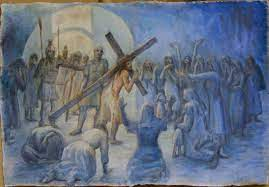
Stations


God’s grace, peace and mercy be with you. … My sermon is entitled Isa and is based on our Gospel (Luke 22:1-23:56). Let us pray. Heavenly Father, the psalmist wrote, “I rejoiced when they said to me, ‘Let us go to the house of the Lord.’” Now that our feet are within your gates, we rejoice to hear your Word. As we listen, may your Spirit enlighten our minds and move our hearts to love deeply as Jesus loved. This we pray to you, Most Holy Trinity. Amen.

Growing up Catholic and spending 20 years of my adult life as a priest, the word station was synonymous with Lent. My parents attended Stations of the Cross every Friday at St. John the Baptist Church in Monaca. As a priest, I led Stations in every parish where I was assigned every Friday afternoon and evening during Lent.

Preparing for this year’s Holy Week, I was reminiscing about these Lenten practices, and wondered if other denominations observe them as well. To my surprise, I discovered that not only do Anglican and Episcopalian churches have Stations of the Cross, but also some Lutheran, Presbyterian, Methodist and Evangelical churches. In fact, the other day, a Pastor told me of a Lutheran Church in Lawrenceville that has the traditional stations, and that his congregation prays the Resurrection Stations during the Easter Season. Hence, three points: What is a Station? What are Scripture’s Stations? What is your Station?

The word station is both a verb and a noun. The latter is much more common. It is defined as a place or position in which something or someone stands or is assigned to stand or remain. It can refer to a person’s standing or rank. It is also a stopping place, such as a bus station or train station. In my work conducting background investigations of military personnel, I would review their duty stations. Likewise, firefighters and police officers are assigned to a particular station. One of my favorite comedy shows, Corner Gas, takes place at a gas station. Finally, everyone knows that Pittsburgh had the first radio stations. Station is a Latin term, statio, meaning the same thing it does in English, and is related to its root, sta, meaning to stand or be firm.

Regarding Stations of the Cross, also known as The Way of the Cross, Lutheran Pastor Gerhard Grabenhofer explains them this way. The Stations came into prevalent use in churches during the Middle Ages. The original Stations or Way of the Cross was the course Jesus walked on His journey to his crucifixion through the streets of Jerusalem. We know this route as Via Dolorosa or the Way of Sorrow. We do not know exactly when it became a practice for pilgrims to walk the Way when they visited Jerusalem, but probably in the 1300’s. When the Turks occupied the Holy Land, they prevented pilgrims from visiting sacred sites. The custom then arose of making simple replicas of the stations and erecting them outdoors or inside churches, and the Faithful could then follow the Way while remaining in their home countries.

By the sixteenth century, fourteen stations were adopted by nearly all churches. Today, pilgrims to the Holy Land may join in procession which follows the Way of the Cross, retracing Jesus’ steps, every Friday.[1] Since most of us will not make a pilgrimage to the Holy Land, we can re-read the account of Jesus’ Way in the Scriptures.

You can read more about the Stations on your own, but now that I’ve explained them, let’s move to the next station, Scripture’s Stations. By Scripture’s Stations, I mean our passage today.[2] So, allow me to explain the traditional Stations as we find them in the Gospels.

Following the Last Supper and the sequence of events that occurred in the Upper Room, the Mount of Olives, and the high priest’s house, Jesus was dragged before the Sanhedrin, Pilate and then Herod, before being condemned to death. This condemnation to death is the First Station. The Second Station, occurs not in the Synoptics (Matthew, Mark, Luke), but in John 19:17, where Jesus carried his cross. This is reminiscent of Genesis 22:6, which reads, “Abraham took the wood for the burnt offering and placed it on his son Isaac. He himself carried the fire and the sacrificial knife, and the two of them walked on together.” The Third, Seventh and Ninth Stations mark three falls of Jesus, which are not mentioned in the Gospels, but given that the Fifth Station is Simon of Cyrene helping Jesus carry the cross, which is mentioned in the Synoptics, it is most likely that Jesus did collapse. I would imagine even the strongest of us would strain to carry a beam of wood after being whipped and beaten.

Although Simon is a minor figure in the Gospels, he is a major figure for us. Here’s why. It was customary in Jesus’ day for a condemned criminal to carry his own cross, and unusual for someone to be forced into service to help him. Luke does not explain why Simon was pressed into service, but his language suggests that Simon was some sort of disciple, literally fulfilling Jesus’ prophesy that a disciple must take up his own cross and follow him. We read this in Luke 9:23 and 14:27.

Mark’s Gospel tells us that Simon was the father of Rufus and Alexander. Rufus and his mother are mentioned in Paul’s Letter to the Romans (16:13). So, it is conceivable that Simon became acquainted with Jesus while carrying his cross and became a believer. We’ve all had conversations on the airplane or on vacation when we spent an hour or so with a stranger who impacted us to a degree. The experience of getting to know a condemned man would have had a greater impact on Simon. Becoming a believer, he could pass along the faith to Rufus.

Symbolically, each of us is Simon, forced to help Jesus carry the cross with love and reverence. As disciples, we know that Jesus’ journey began in Galilee (9:51), and that it ends in Jerusalem. We also know that Jesus created a new people through his teaching and table fellowship. And so, the story of Jesus’ passion is also the story of his followers, who like Jesus are seized and persecuted for their faith.

At this point, Luke adds six additional verses not found in Matthew or Mark. The Eighth Station, where Jesus meets the women of Jerusalem, are among the many people who were following Jesus. It is true that there were people calling for his crucifixion, but there were also people who turned to him in repentance. These are the same people who stood at the foot of the cross (23:48). So, like Simon, the daughters of Jerusalem represent the people of Jerusalem.

As they mourn and lament, Jesus turns to them as he turned to Peter (22:61). His words bring them from remorse to full repentance.[3] All of Jerusalem, Israel and humankind are guilty of rejecting the Messiah who must suffer. Jesus calls all to repent and believe as he warns them of what will happen if they do not.

There are two other Stations that are not in the Scriptures where Jesus meets his mother and a woman named Veronica (a name meaning true icon) wipes his face. On the other hand, all Four Gospels report the last five Stations: Jesus is stripped of his clothes; he is nailed to the cross; he dies on the cross; Jesus’ body is taken down from the cross and laid in the tomb.

Before I get to my third point, let’s explore this question. Is there some significance that Protestant Christians have adopted the Stations as a form of common or personal prayer? Historically, Protestants have tended to reject the practices associated with the Stations of the Cross, largely because they were associated with indulgences. Over the past few weeks, I have read a lot about how Protestant pastors and theologians view the Stations of the Cross. The clearest writing came from Retired Air Force Chaplain Major Robin Stephenson-Bratcher. He wrote, “In our eagerness to celebrate Easter and the resurrection, Protestants often rush too quickly through Holy Week. … Too much of the week, especially as it draws to an end on Good Friday and Holy Saturday is much too messy for Christians accustomed to the language of triumph and praise. In doing so, we miss the tremendous significance of the Cross as something more than a symbol of the crucifixion and death of Jesus as prologue to the resurrection, or as a symbol of a theological doctrine of the atonement. As Jesus himself taught his disciples on more than one occasion, the Cross symbolizes something far more profound than suffering and death, and perhaps even more significant than theologies of the atonement.”

Continuing, he said that the Cross is about the power of love, the commitment of God to humanity, the faithfulness and grace of God that knows no limits and will yield to no boundary, that will risk even death itself for the sake of new life.

Most of us …  do not live in the triumph of Easter Sunday all the time, or even most of the time. Life simply does not work that way. No matter what victory we claim as Christians, the realities of life are too often difficult to bear even for people of Faith. We struggle on the journey and try to understand the inequities of life. We are misjudged and misunderstood by others. We suffer physical and emotional pain. We experience painful endings. Marriages fail. Children make destructive decisions. Friends betray us. Loved ones die. The world becomes dark and hopeless, like the world of Good Friday as Jesus journeyed to the Cross.

In Jesus’ journey to the Cross on Good Friday, we see faithfulness in the midst of his Passion, perseverance in the midst of endings, and courage in the midst of hopelessness. We too take up our own cross, and in accompanying Jesus on the Via Dolorosa, we gain courage from his commitment to the Father in that journey, from his courage to face what comes, and finally from the realization of the truth that with God endings become the building blocks of new beginnings.

The value in the Stations of the Cross lies in the simple twofold enacted confession. First, life is sometimes dark, painful, and brings endings. That reality will not go away even for the Son of God. Second, God does some of his best work in the darkness as we persist in the journey, even when that journey leads to Golgotha. Resurrection Sunday has no meaning without Good Friday. This journey reminds us of the darkness as a basis to celebrate the light.[4]

Finally, What is your Station? Earlier I offered definitions of the word. Station can be your status in life, your place, where you stand. Our stations differ and in time they change. Recently, I turned 65. In our society, turning 65 brings a major change – Medicare. Apart from that, my station in life has changed quite a bit over the last six decades. Once upon a time, my station was being a young person attending school with my brothers and schoolmates. I was learning subjects in school, how to play the trumpet and accordion, how to drive a standard transmission and dance the polka. My station was to be a young man.

Professionally, my station changed. I was a pastor and chaplain before becoming a nonprofit fundraiser. Personally, my station changed when I met Cindy, and became her husband. In-laws and grandchildren offered the station of father-in-law and grandfather. And two years ago, you offered me the station of pastor once again.

As a pastor, my primary interest is for you to develop and sustain your prayer life, your relationship with our Triune God and with one another as members of Christ’s Church. At times, that is not an easy task. It’s not as difficult as carrying a cross to Calvary, but it does place a burden, an obligation on me because you are all at different stations in your lives. You are at a different station today than ten years ago, and so is this congregation. Your life has changed dramatically in ten years as individuals and a church, and hopefully, through all of that your relationship with God and one another has deepened. That’s why this station in my life as your pastor is just as important as husband, grandfather, brother, neighbor, friend and so on.

I see you like Simon, as one pressed into the service of helping Jesus bear his cross. Circumstances have changed your life. One minute you’re going home and the next minute, you’re thrust into a new situation, and your relationship with Christ and those around you will never be the same. One moment, you’re anonymous, and the rest of your life you are remembered as the one who bore the cross of Christ.

I see you as the women Jesus met. In moments of grief, sorrow, anger or depression, Jesus offers a word to you: a consoling word, an uplifting word, a word of forgiveness and mercy. You may never find yourself standing on the Via Dolorosa, but you need to hear God speak those words to you in your living room, the hospital room, the funeral home. My friends, I pray that you take time this week to enter into Christ Passion by reading the Gospels. And I pray that wherever you are when you hear Jesus’ words that the peace of God that surpasses all understanding keeps your hearts and minds in Christ Jesus. Amen.


[1] Explanation from Pastor Gerhard Grabenhofer, Faith Lutheran Church, Corning NY. This is an LCMS congregation. See file:///C:/Users/Owner/Downloads/good-friday-stations-of-the-cross-2018.pdf

[2] For a guide to the Traditional Stations and a Scriptural reference to each one, see this website: https://catholic-resources.org/ChurchDocs/Stations_of_the_Cross.htm. A web search of Stations of the Cross prefaced by the denomination will provide churches which offer them as a form of prayer.

[3] Arthur A. Just, Jr., Luke 9:51-24:53. St. Louis: Concordia Publishing House (1997), p. 918.

[4] Dennis Bratcher, “The Cross as a Journey: The Stations of the Cross for Protestant Worship.” https://www.crivoice.org/stations.html. You can also read these: https://www.christianity.com/wiki/christian-terms/the-stations-of-the-cross-can-we-learn-from-them.html; https://www.gotquestions.org/stations-of-the-cross.html.

Friday, April 1, 2022

God Restores our Fortunes


Have you ever lost something and then got it back? I have lost some things and then got them back – a watch, a credit card, a coat. I’ve never lost anything really valuable, but I know a couple of people who have lost things and got them back.

On St. Patrick’s Day, I was walking my Golden Retrievers, and in the middle of our road, I found a wallet. I looked inside and saw that it belonged to our neighbor. I returned the wallet to his house. He was very glad to get it back.

A few years ago, I was walking from my car into a big hardware store when I found another wallet. I looked inside and found the owner’s name. He had over $800 in cash in his wallet. He was very, very happy that he got it back. He was so happy that he wanted to give me some of his money.

I mention those two instances of people getting back something that was lost because our Psalm today (126), tells us that “when the Lord restored the fortunes of Zion, we were like those who dream.” In other words, the people who got back what they lost were so happy that they thought they were dreaming.

When people are so happy that they think that they are dreaming, they say, “Pinch me! I must be dreaming.” Because we are sinners, we have lost everything, but through Jesus, God has restored our friendship with the Him. Because God has given us back new life and the everlasting life that we lost, we are so happy – happier than those men who lost their wallets and got them back. Today, be happy because of what God does for you.

With that, let us pray. Heavenly Father, from whom all fatherhood in heaven and earth is named: Bless these and all children, and give their parents the spirit of wisdom and love, so that the homes in which they grow up may be to them an image of Your Kingdom, and the care of their parents a likeness of Your love. We pray in the Name of the Father and the Son and the Holy Spirit. Amen.

Thursday, March 31, 2022

Isaiah: Who, What, Why?


God’s grace, peace and mercy be with you. … My sermon is entitled Isaiah: Who, What, Why, and is based on our First Reading (Isaiah 43:16-21). Let us pray. Heavenly Father, the psalmist wrote, “I rejoiced when they said to me, ‘Let us go to the house of the Lord.’” Now that our feet are within your gates, we rejoice to hear your Word. As we listen, may your Spirit enlighten our minds and move our hearts to love deeply as Jesus loved. This we pray to you, Most Holy Trinity. Amen.

I attended Potter Township Elementary for eight years, and was a member of the last graduating class in 1971. It was a wonderful eight-year experience for me. It was the first time I was on television. On Junior High Quiz, our small class of eight defeated a much larger junior high school team before losing on our second appearance. One of the fondest memories I have was Mr. Reed’s English class. Mr. Reed did everything. He taught English and Gym. He ran the summer recreation program and gave golf lessons. And he sent us to the blackboard every day for two years so that we learned how to diagram sentences, because, as he said, “When you get to high school no one is going to teach you how to write.” And he was correct.

So, here’s an English lesson for you. Who, What and Why are pronouns. Who is a singular and plural nominative case interrogative pronoun. That’s a statement, not a question. An interrogative pronoun is used to ask the identity of someone. Interrogative is a combination of the Latin words inter meaning between and rogare meaning to question or cross-examine. In January 1969, local sportswriters asked, “Who is Joe Greene?” Today, we ask, Who is Isaiah? What was his message? Why is that important to us?

Who is Isaiah? Although he was one of the greatest writing prophets, the New Testament cites his book 68 times, not much is known about his personal life. He was the son of Amoz. His name means ‘The Lord saves’. He was a contemporary of Amos, Hosea and Micah, and began his ministry in 740 B.C., the year King Uzziah died. According to an unsubstantiated Jewish tradition, he was sawed in half during the reign of Manasseh.[1] Isaiah was married and had at least two sons, Shear-Jashub meaning ‘A Remnant Shall Return’ and Maher-Shalal-Hash-Baz meaning ‘Speed-Spoil-Hasten-Plunder’ which referred to the Assyrian invasion. He probably spent most of his life in Jerusalem, enjoying his greatest influence under King Hezekiah.[2] Isaiah is also credited with writing a history of the reign of King Uzziah.[3]

Many scholars today challenge the claim that Isaiah wrote the entire book that bears his name, but there is no convincing proof that the book was written by three different authors. His is the only name attached to it.[4] The strongest argument for the unity of Isaiah is the expression ‘the Holy One of Israel,’ a title for God that occurs 26 times throughout the entire book. There are also striking verbal parallels throughout and 25 Hebrew words or phrases that occur in no other prophetic writing. In my humble opinion, he alone wrote the longest prophetic book in the Bible.

Isaiah’s work influenced contemporary and later prophets. His life and writing affected Jesus, the Evangelists and Paul. Matthew wrote in chapter 12 that Jesus’ actions fulfilled what Isaiah prophesied.[5] Matthew and Luke cited Isaiah when they described John the Baptist.[6] John cited Isaiah when he wrote of how Jesus fulfilled the prophecy that people refused to believe in Jesus.[7] In writing to the Romans, Paul too spoke of people’s belief and unbelief in Christ.[8] Because Isaiah was so influential on Jesus and His followers, we are studying many passages of his book in Sunday School this year.

We segue from who to what. What was Isaiah’s message? Isaiah wrote during Israel’s stormy period not long after the Kingdom’s tribes split into two. Ten of the tribes in the north are referred to as Israel; two of them in the south – Benjamin and Judah – are commonly known as Judah. This split occurred in 930 B.C. For 200 years before Isaiah appeared on the scene, these two kingdoms fought wars, battles and skirmishes against each other. In the meantime, the Assyrian empire – now known as Iraq – expanded while both the kingdoms of Israel and Judah declined.

Fearing annihilation, King Ahaz of Judah formed an alliance with Assyria, which then conquered the northern kingdom. This was politically and militarily prudent, but not wise and not what God wanted. It makes me wonder how astute or obtuse advisors were (and are). Eventually, Ahaz died, but like many others before and after him, not in God’s good graces.

The godly King Hezekiah who succeeded Ahaz prayed that God would save Judah from Assyria, which threatened to annihilate the nation. Hezekiah also sought the counsel of Isaiah, who predicted that God would force the Assyrians to withdraw from the city.[9] Nevertheless, Isaiah warned Judah that her sin would bring captivity at the hands of Babylon (also modern-day Iraq). Although this did not take place until after their death, Isaiah predicted both the destruction of Judah and the people’s exile, as well as its eventual restoration and the people’s return from captivity.[10]

Isaiah prophesied that God would redeem his people from Babylon just as he rescued them from Egypt. He predicted the rise of Cyrus the Persian (Iran), who conquered Babylon, and allowed the Jews to return home. This occurred in the years 538-537 B.C.

His passage today (43:16-21) is a reminder and a promise. It is a reminder of what God did in the past, specifically, the Exodus event. It is also a promise of what God will do in the future, a new thing, a new way in the wilderness and rivers in the desert, a new Exodus.

Folks, the past can teach but it must not bind. Understand that God is not predictable like the pagan gods. As Creator, God loves doing things in new ways. Therefore, the people’s gaze must always be forward to what God will yet do. It is not that the Lord would rewrite history but that His people should live in the present reality of their Deliverer, their Exodus God.[11]

The new thing God would do was deliverance from Babylon; a national liberation patterned on the Exodus. In v. 19, the word springs is like a seed that is germinated and its time has come. And in v. 20, we see how God would transform the whole world into harmony. As God’s people journey through the wilderness, they see that in this transformed world even wild animals enjoy it and are enjoyed by the faithful.

The passage concludes in v. 21, with “The people I formed for Myself will declare My praise.”[12] Here, the potter image is a way for Israel to understand that they can look with confidence at and through their impending troubles. The people who experienced God’s wrath[13], are touched by the potter’s hand as he perfects what he planned to create. The Babylonian exile and the ultimate return of people to their homeland through Cyrus the Persian King have their parts to play until the day comes when a perfected people will perfectly recount the praise of their Lord.[14]

Finally, why is this message important to us? Commenting on this passage, John Oswalt writes, “Remember the lessons of the past, but forget the methods. … Whenever we find something that works for us, we hang on to it with all the tenacity of a leech. … Maturation is the process of accumulating things that work and discarding those that do not. … But the great danger of maturation is calcification. We finally figured things out. We know what we want, and we know how to get it. The result is that we don’t need faith any more.”[15]

He says that the seven last words of any church are, “We’ve never done it that way before.” (That’s a play on Jesus’ last seven words before He died.) That doesn’t mean that every new thing is better. We don’t need to change Christ’s words when we baptize or celebrate Lord’s Supper. With all due respect to the talented Steven Curtis Chapman, Amy Grant, Michael W. Smith and Chris Tomlin, it’s tough to make the case that a church adopt their music and discard hymns like When I Survey the Wondrous Cross, Jesus Christ is Risen Today. Ode to Joy or A Mighty Fortress is Our God.

When we look back through history, we see what God did and how He did it when we read of the mighty deeds of creation and salvation in Genesis and Exodus. We see the strength of Samson; the victories of David; the wisdom of Solomon. We read the poetic wisdom of Psalms and Proverbs; how God protects Job and what it means to be faithful throughout trials and tragedies. We study the prophets to see how God acted through them to remind His people to return to the Covenant, to remember that He alone was their God and that they were His people. Elijah’s sacrifice on the mountain. Elisha raising to life the son of the Shunammite widow.

The Old Testament is filled with lessons to learn how to live a faithful life. When we get to the New Testament, we read about Jesus’ teachings and healings; how he mastered storms and demons; how he provided food and drink for people’s stomachs and souls; how he remained steadfast to His Father’s will despite inhumane insults, an unjust trial and torturous beatings before dying painfully as a condemned criminal, rejected by his people and abandoned by his friends. We know the Father’s love and power which raised a dead man to everlasting life; and the power of the Holy Spirit in the lives of Peter, Andrew, James, John, Paul, Mary Magdalene, Mary the mother of Jesus, and many more. As faithful Christians, we know and have applied those lessons to our own lives.

Many of us have seen the work of the Holy Spirit in a vibrant church and in a faithful remnant. We have thanked God who pulled us through surgeries and sickness. We have reflected upon how the Holy Spirit initiated our relationships, friendships, marriages and families. God has protected our loved ones and ourselves from tragic accidents and violent acts, from natural disasters and manmade calamities. Christ’s power of love has saved us from Satan, sin and self. And when sickness and suffering, disease and death did strike us, we have seen the outpouring of love through other believers and at unexpected moments in solitude and silence, like a tiny whisper of the Father’s voice, a gentle breeze of the Holy Spirit, and the warmth of Jesus’ love.

So, what can we learn from Isaiah’s passage today? We take all of those memories and experiences, and forget about them. Remember not the former things, nor consider the things of old. Behold, I am doing a new thing; now it springs forth, do you not perceive it?

I started this sermon by telling you what I learned in elementary school and how that helped me in my life. When I stepped away from ministry 15 years ago, I started a successful career in fundraising. I wrote appeal letters and grants. I obtained funds to feed people in Pittsburgh. I secured grants to house homeless women and veterans in Berkeley (CA). I managed events to support church planters, awareness for people with autism, and agricultural programs in rural Africa, Asia and Latin America. God took what I learned at Potter Township Elementary School, and showed me a new way to serve Him. God formed me in my early years for Himself so that I might declare His praise. And now, I look for new ways that God works in my life as a husband, grandfather, man, neighbor and your pastor.

How God is working new things in my life is like watching an episode of Beat Bobby Flay. He takes a familiar dish and enhances it in ways he’s never served it before. He’s amazing. God is even more amazing. The people I formed for Myself will declare My praise.

So, what about you? How is our amazing God working new things in your life?


My friends, thank you for sharing how God is working new things in your life. In closing, I pray that the peace of God that surpasses all understanding will keep your hearts and minds in Christ Jesus. Amen.


[1] Hebrews 11:37.

[2] Isaiah 7:3; 8:3; 37:1-2.

[3] 2 Chronicles 26:22.

[4] Isaiah 1:1; 2:1; 13:1.

[5] Matthew 12:17-21; Isaiah 24:1-4.

[6] Matthew 3:3; Luke 3:4; Isaiah 40:3.

[7] John 12:38-41; Isaiah 53:1; 6:10.

[8] Romans 10:16,20; Isaiah 53:1; 65:1.

[9] Isaiah 37:6-7.

[10] Isaiah 40:2.

[11] J. Alec Motyer, The Prophecy of Isaiah: An Introduction and Commentary. Downers Grove IL, IVP Academic (1993), p. 337.

[12] This version is the Berean Study Bible which sometimes reads better than the ESV.

[13] Isaiah 42:25.

[14] Motyer, p. 337.

[15] John N. Oswalt, Isaiah: The NIV Application Commentary Grand Rapids, MI, Zondervan (2003), p. 497.