Wednesday, June 18, 2025

Declaration Day


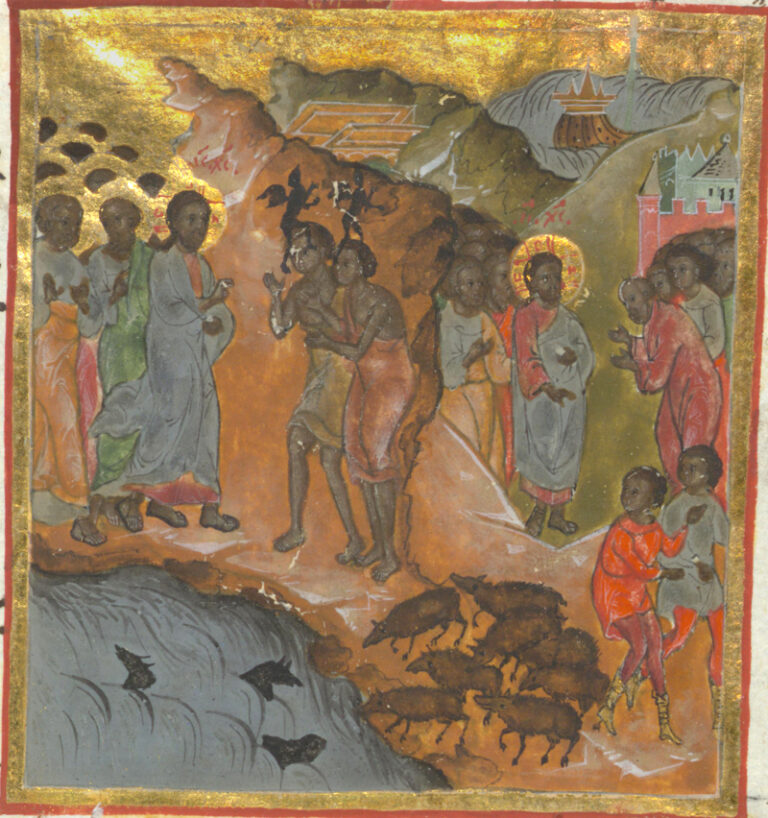
God’s grace, peace and mercy be with you. My sermon is entitled Declare How Much God Has Done for You, and my focus is our Gospel (Lk 8:26-39). … Let us pray. Heavenly Father, the psalmist wrote, “I rejoiced when they said to me, ‘Let us go to the house of the Lord.’”  Now that our feet are within your gates, we rejoice to hear your Word. As we listen, may your Spirit enlighten our minds and move our hearts to love deeply as Jesus loved. This we pray to you, Most Holy Trinity. Amen.

In less than two weeks, we will celebrate Independence Day, a federal holiday commemorating Continental Congress’ adoption of the Declaration of Independence on July 4, 1776. We declared that the thirteen American colonies regarded themselves as a new nation, the United States of America, and no longer part of the British Empire.

While we associate Independence Day with fireworks, family reunions, parades, picnics and political speeches, we also celebrate our nation’s history, government and traditions. All of this occurs annually because of the Declaration of Independence.

A declaration is a public statement. When I declare something, I say it in an official or public way, a strong and confident manner, or I simply tell the government how much money I earned to pay taxes.

Directly from the Latin words de and clarare, it means to make clear, reveal, disclose, announce. People declare their candidacy for President of the United States and many others declare their support for a candidate. Judges declare sentence on the accused. Champions declare victory, and individuals declare bankruptcy.

In our Gospel today, Jesus ordered the man to declare how much God has done for you.[1] Before we declare how much God has done for us, my third point, I examine our passage and what it meant to the Church. In short, Passage, People of the Way and People Today.

First, Passage. The account is an exorcism and follows the usual pattern for an exorcism.[2] Demons inhabited deserts, large bodies of water, the air and subterranean regions. They caused blindness, muteness, all kinds of physical problems and mental disorders. Demon possession was physical or mental possession, not moral. Luke wrote that seven demons went out of Mary Magdalene. We assume she was immoral. She was not. All Scripture passages portray her as serving the Lord.


In today’s passage, so many demons possessed the man that it was named legion. He was naked and lived among the tombs, frightening local citizens with his bizarre behavior, but there is no mention of their influence over his moral life.

Since demons were from the supernatural world, they recognized Jesus as a person of God and an opponent of all forces that hurt, cripple, oppress or alienate human life. In his inaugural address, Jesus announced his intention to relieve, release, heal and restore life. We read in chapter 4, “The Spirit of the Lord is upon me, because he has anointed me to proclaim good news to the poor. He has sent me to proclaim liberty to the captives and recovery of sight to the blind, to set at liberty those who are oppressed.”[3] All persons or powers to the contrary must view him as an enemy.

Jesus was not the only exorcist working the land. In chapter 9, when John the Apostle reported, “‘Master, we saw someone casting out demons in your name, and we tried to stop him, because he does not follow with us,’ Jesus said, ‘Do not stop him, for the one who is not against you is for you.’”[4] When some challenged his authority to exorcize demons, Jesus responded, “If I cast out demons by Beelzebul, by whom do your sons cast them out?”[5] We also read about Jewish exorcists in Acts.[6]

The demons recognized Jesus and his power. He could send them to the abyss or netherworld, that is, Satan’s prison.[7] They knew the abyss was their prison and that it was not beyond the power of Christ. So, they begged to be sent into unclean animals to escape their fate.

Mercifully, Jesus allowed their request. He did not take pleasure in anyone’s death or in torturing demons for “God did not send his Son into the world to condemn the world, but in order that the world might be saved through him. … But whoever does not believe is condemned.”[8]

The unclean spirits entered the unclean animals that plunged into the abyss and were banished. We hear nothing more of them. Instead, Luke reports that the people of that village found the man sitting at the feet of Jesus, clothed and in his right mind. Afraid, they asked Jesus to depart.

At this point, you might be wondering why the villagers asked Jesus to leave. Luke’s second book, Acts, helps answer our question. In chapter 16, we read that as Paul and Silas were in Philippi, they “met a demon-possessed slave girl. She was a fortune-teller who earned a lot of money for her masters.

She followed Paul and the rest of us, shouting, ‘These men are servants of the Most High God, and they have come to tell you how to be saved.’ This went on day after day until Paul got so exasperated that he turned and said to the demon within her, ‘I command you in the name of Jesus Christ to come out of her.’ And instantly it left her. Her masters’ hopes of wealth were now shattered, so they grabbed Paul and Silas and dragged them before the authorities at the marketplace. ‘The whole city is in an uproar because of these Jews!’ they shouted to the city officials. ‘They are teaching customs that are illegal for us Romans to practice.’ A mob quickly formed against Paul and Silas, and the city officials ordered them stripped and beaten with wooden rods. … and then they were thrown into prison.” After the earthquake opened the prison doors, the city officials begged Paul and Silas to leave their city.[9]

Philippi’s city officials and Gerasene’s villagers asked the Apostles and Jesus to leave out of economic loss and fear. They learned to live with the evil spirits but were afraid of an unknown power greater than evil spirits.

The Gerasene villagers knew where evil resided and spent considerable time and expense guarding and containing it. They tolerated and managed evil, but the power of God disturbed the way of life they had come to accept. People fear change, and in order to accept the changes God brings, we must ask the Holy Spirit to help us see that a particular change might be God’s good and gracious will.

Let me leave my first point, and segue into my second, People of the Way. People of the Way described the first followers of Jesus. They were named Christian when Barnabas brought Saul to Antioch. We read, “For a whole year they met with the church and taught a great many people. And in Antioch the disciples were first called Christians.”[10]

What did the first Christians take from this brilliantly told passage? Irony. Given Christianity’s origins in the Jewish world, Luke’s Gentile readers were keenly sensitive to Jesus sending unclean spirits into unclean animals. They enjoyed the fact that the demons unwittingly invited their own banishment into the abyss.[11]

While that generated fear among the Gerasene villagers, the first Christians also took courage from this passage. It gave them courage to overcome any fear about proclaiming the Gospel and declaring how much God did for them. Because Jesus, a Jew, was not afraid to cross into Gentile territory, they too – baptized in His Name – could cross cultural, societal, racial and economic boundaries to proclaim the Gospel.

Jesus, anointed with the Holy Spirit, faced demons and enemies who opposed Him and His work – proclaiming good news to the poor, liberty to captives, recovery of sight to the blind, and freedom to the oppressed. People of the Way also faced demons and enemies who opposed them and their work. They endured imprisonment, beatings, stonings, mockings and death. They endured this from people who feared the power of the Gospel.[12] The People of the Way learned a lesson in courage by proclaiming what God did for them.

Finally, People Today. We are People of the Way today. The word synod means walking together. Soon, a new man will start walking with you, and there is a feeling of excitement in the congregation about his arrival. So, let me close on this point by asking a question: What has God done for you personally?

That is too difficult for me to answer, but I have seen what God has done for us as a congregation. When I arrived for the first Divine Worship Service at the end of April 2020, only a handful of us were present for an online Service. At the end of May, we gathered on Pentecost for in-person Worship. There were about 15 people wearing masks. It stayed that way for a while and then grew to about 25 people. There was talk about closing because of past mistakes and a shortage of funds.

There were some highpoints such as the confirmation of seven teenage girls and moving the Christmas Vigil to 4:00 PM which resulted in 90+ people worshipping with us. After we moved into this building, I started some new ministries: Ushers and Greeters, scheduled readers and regular acolytes. We now have an active Women’s Group and a Men’s Bible Study. But the greatest thing that God has done while I have been your Pastor is to increase membership, including people who had left prior to my arrival. Weekly attendance doubled since 2019 and 2020, from 30 to 60. I have been your Pastor, but the Holy Spirit works through me because I ask God to do that. It is God’s good and gracious will that He has been able to accomplish much here through me, through us.

Eventually, as I started serving as Pastor of St. John’s, I approached the District President about calling a younger man to serve two congregations. I was directly involved in the call process because I really wanted this to succeed sooner than later. More than wanting to retire, I wanted a young, energetic man serving both congregations successfully. And he will do that if you support him. Pray for him daily and tell him how God has worked in our congregation over the past five years. Tell him how you are going to help him double the current size of this congregation. Tell him how we, as a congregation, will financially support the parish, and Lutheran ministries and missionaries. If Lutherans do not support Lutheran ministries and missionaries, who will?

Regarding how you should respond to what God has done for you personally, there are opportunities for each of us to proclaim that. And with that, I would like to say this. The older I get, the more I realize how God provides for me and blesses me. Even on my worst days, God fills my heart with joy because of what He does for me. At times, I wonder how to thank God properly for what He has done and does for me. And our God, who simplifies everything, even provides my response.

The Psalmist wrote, “I love the Lord for he has heard the cry of my appeal; for he turned his ear to me in the day when I called him.” He continued. “How can I repay the Lord for his goodness to me? The cup of salvation I will raise; I will call on the Lord’s name.”[13] Sound familiar? It is our traditional offertory.[14]

Friends, during the Lord’s Supper, we raise the cup of salvation and call on the Lord’s name. That is why Christians have always called the Lord’s Supper, Eucharist. Eucharist is simply a Greek word that means thanksgiving.

Our post-communion prayer reads, “We give thanks to You, almighty God, that You have refreshed us through this salutary gift, and we implore You that of Your mercy You would strengthen us through the same in faith toward You and in fervent love toward one another.”[15]

Friends, God simplified life and worship. We need not revise praise and thanksgiving. Praise and thanksgiving occur every time we worship. Each Sunday when you worship, you declare how much God has done for you. Do that and may the peace of God that surpasses all understanding keep your hearts and minds in Christ Jesus. Amen.


[1] Luke 8:39

[2] Fred Craddock, Luke (Louisville: Westminster John Knox Press, 2009), 65f.

[3] Luke 4:17-18.

[4] Luke 9:49-50.

[5] Luke 11:19.

[6] Acts 19:13-17.

[7] Philippians. 2:9-11; Romans 10:7; 1 Peter 3:19; Revelation 20:3.

[8] Ezekiel 18:32; John 3:17-18.

[9] Acts 16:16-23, 38-39. New Living Translation.

[10] Acts 11:25-26.

[11] Eugene LaVerdiere, Luke (Wilmington, DE: Michael Glazier, Inc., 1986), 119f.

[12] Read Acts and 2 Corinthians 11.

[13] Psalm 116:1-2, 13-14.

[14] Lutheran Service Book (St. Louis: Concordia Publishing House, 2006), 159.

[15] LSB, 166.

Friday, June 13, 2025

Dance Acts


God’s grace, peace and mercy be with you. … My sermon is entitled Dances and Acts and is based on Acts 2:22-36. Let us pray. Heavenly Father, the psalmist wrote, “I rejoiced when they said to me, ‘Let us go to the house of the Lord.’” Now that our feet are within your gates, we rejoice to hear your Word. As we listen, may your Spirit enlighten our minds and move our hearts to love deeply as Jesus loved. This we pray to you, Most Holy Trinity. Amen.

Throughout my high school years, my family was very active in the Polish National Alliance in Monaca. We were part of the Krakowiaki, a youth group that performed traditional Polish songs and dances throughout Western Pennsylvania and Eastern Ohio. If you’ve ever been part of a dance group, you know that everyone must practice his or her parts many times before you can perform it before others. The same principle applies to team sports, marching bands and plays. We call this choreography.

Choreography is the art or practice of designing sequences of movements of physical bodies in which motion or form or both are specified. It came to the English language from the Greeks. Khoreia means dance and graphein means to write. The word means dance-writing.

I open my sermon with this illustration because it helps us appreciate the Mystery of the Trinity. I say appreciate because it is difficult to fully understand any true mystery, especially if I am the type of person who can figure out even the most complex sciences or house repairs.

The Church Fathers described the inner life of the Trinity as perichoresis. Peri means “around” and chorein I have just explained. Perichoresis means “to make space around.” It points to the way in which someone or something makes space around itself for others or for something else. It is a picturesque word that suggests a kind of swirling or a dance. In the dance of love in the Trinity, Father, Son and Holy Spirit make room for one another. They dance about and with one another in a way that shows a mutual indwelling while still maintaining space for each person.

I will return to dance later, but now a question: Have you ever wondered why we celebrate Trinity Sunday? Think of Trinity Sunday in terms of Mother’s Day or Father’s Day. Most people love and appreciate their mothers and fathers and understand the importance of motherhood and fatherhood. Why set aside Sundays in May and June to celebrate mothers and fathers? It’s not that we remember them only one day a year. If they are alive, we show our love and appreciation on a regular basis. Regarding the Trinity, we have come to know and understand how God the Father, Son and Holy Spirit are important to our true Christian Faith and set aside one Sunday a year to specifically celebrate the Trinity.

To us, it may be assumed that all who follow Christ agree with our teachings about the Divine Personhood and the two natures of Jesus Christ. Yet, there is a long history of individuals and church bodies whose teachings do not agree with ours. These are based on a condemned heresy known as Arianism.

Arianism is a heretical sect named after its founder, Arius, a 3rd-century priest from Alexandria, Egypt. Arius opposed the theological doctrines held by Christians regarding the nature of the Trinity and the nature of Christ. He and his followers believed that Jesus Christ is the Son of God, who was begotten by God the Father with the difference that the Son of God did not always exist, but was begotten within time by God the Father, meaning that Jesus was not co-eternal with God the Father. The Son is distinct from the Father and subordinate to him, and not a co-equal Person of the Trinity. In short, they did not believe in the Trinity as we do.

Principally, the dispute between Trinitarianism and Arianism can be boiled down to two questions. First, has the Son always existed eternally with the Father or was the Son begotten at a certain time in the past? Second, is the Son equal to the Father or subordinated to Him?

This controversy continued until Emperor Constantine called the First Council of Nicaea (325 AD), which defined the dogmatic fundamentals of the Christian religion. From this Council, we have the Nicene Creed. For 1700 years, the Council and Creed served to rebut the questions posed by Arians. Still, the controversy did not go away. It lingered for centuries because many Christians in the 3rd and 4th centuries did not understand or appreciate a clear teaching of the Christian faith and went along with what was being taught in their local churches.

Unfortunately for the Arians, Bishop Athanasius, who attended the Nicene Council and refused to accept Arianism, pushed back on the sect’s false teaching. He opposed it so strongly that he was exiled from his office and city. The Athanasian Creed is attributed to him, and accepting it leaves little wiggle room for questioners of our Faith, which is why it is one of the three creeds found in the Lutheran Book of Concord, and why we recite this creed on Trinity Sunday.

The focus of this Creed should deepen our understanding that some religious bodies today do not believe in the Trinity as we do. Many of the core beliefs of Unitarians and Jehovah's Witnesses are similar to Arianism. Mormons or Latter-day Saints do not accept the Nicene definition of Trinity. So, from our perspective, the beliefs of these and a number of splinter Pentecostal Churches that are not Trinitarian are not Christian as the Book of Concord defines a Christian. This is not to say that the people who belong to these religious bodies are bad, but, like Athanasius, we need to be clear on what we believe and hold true.

That said, we turn to Acts. The first thing Peter did was get his audience’s attention. In v. 14, Peter shouted, “Men of Judea and all who dwell in Jerusalem, let this be known to you, and give ear to my words.” In today’s opening verse, Peter addressed his audience in these words, “Men of Israel, hear these words: Jesus of Nazareth, a man attested to you by God with mighty works and wonders and signs that God did through him in your midst, as you yourselves know.”

Acts’ author, Luke, wants us to know that Peter was in Jerusalem of Judea, and first got their ears. Peter also knew that God’s people were the People of Israel and were in Jerusalem for the Passover or the Feast of Shavuoth. Therefore, all present heard Jesus’ words or saw his works. Now that Peter drew their attention to Jesus of Nazareth, a Galilean, which meant Jesus was neither a Judean nor a dweller of Jerusalem, but a Man of Israel.

As he spoke, Peter indicted his listeners for having crucified Jesus. The Resurrection, however, confirmed that Jesus’ death was part of God’s plan, as Christ Himself foretold.[1] Peter then delved into Psalm 16, in which David expressed his trust and confidence in God, but pointed out that it was actually Jesus speaking through the mouth of David. After his struggle in the Garden of Gethsemane, when Jesus submitted his will to the Father, he was no longer disturbed but serene and courageous, knowing that his Father would deliver him.[2]

Psalm 16 expresses Jesus’ confident hope that he would be raised from the dead. Now, keep in mind that Jews viewed that physical decay began on the fourth day after death. Martha commented that her brother, Lazarus, had been dead for four days, and there would be a stench in his tomb. Unlike Lazarus, Jesus was raised on the third day – a prophetic sign that he did not nor would not see corruption.

Peter points out that the psalm could not apply to David because his tomb was in their midst to that day. Jesus’ tomb, however, was empty. David was buried for 1,000 years, and so in Psalm 16 spoke of his descendent, Jesus. David foresaw and spoke of the resurrection of the Messiah. No one could dispute Peter because he and the others were actual eyewitnesses of the Risen Christ and His empty tomb.

What is going on here is a conversion. When Peter said, “Give ear to my word,” and “hear these words,” he invited careful hearing and encouraged his listeners to shift their thinking. The people who heard Peter were now ready for a radical makeover of their patterns of faith and thought. What follows in the next verses is an affective response. His listeners were cut to the heart, the center of emotion and understanding, their innermost being.[3] Next, they referred to Peter and the others as brothers, echoing his address in verse 29.

Peter aimed to connect with his audience in a personal, family manner and succeeded. The result was that they were now not only ready to embrace a common understanding of Jesus’ identity and role in God’s saving purpose, but also to respond with a solid commitment.[4]

So, what does all of this (my explanation of why we celebrate Trinity Sunday and an effective teaching on Acts) have to do with us today? The answer to my question is found in a question from Acts 2:37, when the hearers ask, “What shall we do?” And the default answer to that is always, “Repent and be baptized every one of you in the name of Jesus Christ for the forgiveness of your sins, and you will receive the gift of the Holy Spirit.”[5] Those who were baptized also repented and received the gift of the Holy Spirit.

Folks, Baptism is a community affair, not a simple personal and private affair between God and me. Baptism for the forgiveness of sins admits me to the Church, the Christian community. And if I have excluded myself from the community through sin (and I do), repentance and forgiveness readmits me. We should never forget that the divine forgiveness that we receive through baptism or the pastor’s words of absolution during our Divine Service was central to the promise of Israel’s restoration.

Peter depicted baptism as the appropriate individual response to the Gospel. “Everyone of you” or “Each of you” means that I come to the Church of those already baptized and ask for the Sacrament. I cannot baptize myself no matter how strong my emotions are. When I seek baptism that means that I submit myself to baptism by the community, the Church. As Church, we embrace those who present themselves for baptism because baptism means belonging. Baptism is a response and a gift.

Baptism “in the name of Jesus Christ” provides focus for us. Looking at Peter’s Pentecost speech, we are to call on no one else other than Jesus Christ for salvation. It also means that we embody the discipleship as spelled out in Jesus’ ministry and teaching. And if we do that, we cannot embrace contradictory teachings and lifestyles.

Now, let’s return to our dance. Before Cindy and I married, we took dance lessons at Arthur Murray Dance Studio. We learned the Foxtrot, the Salsa, the Cha-cha and the Tango. Don’t expect me to teach you anything other than a waltz or a polka, and my lessons don’t come cheap. All kidding aside, I am returning to dance because part of being a theologian, a pastor, a Christian is learning how to dance with the Holy Spirit.

How do you dance with the Holy Spirit? First, let the Spirit lead. Trying to lead the Holy Spirit is like dancing with two left feet. Second, learn the steps. By that I mean that you need to read your dance manual. Arthur Murray was successful at teaching people how to dance because he taught one step at a time. Finally, practice. Let the Holy Spirit teach you how to read your dance manual, that is, your Bible, one page at a time, one chapter at a time, one book at a time. An intimate relationship with our Triune God is not based on emotions. It is based on faith (what we believe) and how we live those beliefs (loving our neighbor through actions). Just as you practice choreographed in dance or sports to excel at it, you practice beliefs and works to become the saint God calls you to be.

Let the Holy Spirit lead you in prayer one moment at a time, one session at a time, one day at a time. As the master teaches dance troupes, marching bands, ballet companies and football teams to learn their movements one at a time, so does the Holy Spirit. And the key word is practice. If I want to have fun dancing with the Holy Spirit, I need to spend time practicing steps.

Now, Satan can mislead us into thinking that we do not need the Holy Spirit or practice. He says that I can make up my steps as I go along, just as I make up rules for living as I go along. If I think that I can change or water down Church teaching, I become another Arius. When I betray other believers just to get them to do what I want, I become another Judas, and it will not end well for me. That is why I recited Luther’s Sacristy Prayer last week. That is why we are going to speak The Athanasian Creed today. That is why I must cling to Christ crucified. That is why I speak the Lord’s Prayer out loud.

Friends, all of us experience sickness and healing, love and heartbreak, success and failure, new life and death. Through all these experiences, our partner, the Holy Spirit, the Third Person of Holy Trinity, is with you. The Spirit leads you, embraces you, comforts you, celebrates you, loves you. The Holy Spirit is calling you to learn and practice your steps. The Holy Spirit calls you to read Scripture daily, to re-read and study your Small Catechism because there is a lot you do not know about the teaching of the Church.

In a month, you will have a new pastor, and the Holy Spirit will teach you through him to dance as a couple. Remember that there are only two members of this congregation: the pastor and the congregation. That means you need to practice because only the congregation as a whole can dance with the pastor. So, practice reading God’s Word, obeying God’s Commandments, living the Lord’s Prayer, and being Christ for others. Take time this week and ask the Holy Spirit to teach you how to dance like Fred Astaire or Ginger Rogers, or whoever your favorite dancers are, and when you do, may the peace of God that surpasses all understanding keep your hearts and minds in Christ Jesus. Amen.


[1] Luke 9:22,44; 18:31-33.

[2] William S. Kurz, Acts of the Apostles. Grand Rapids, MI: Baker Academic (2013), p. 54.

[3] Joel B. Green, Conversion in Luke-Acts. Grand Rapids, MI: Baker Academic ((2015), p. 127.

[4] Ibid.

[5] Acts 2:38.

Friday, June 6, 2025

Pentecost's Three P's


God’s grace, peace and mercy be with you. My sermon is entitled The 3 Ps of Pentecost: Pneumatology, Passage, Practical Application. My focus is Acts 2. Let us pray. Heavenly Father, the psalmist wrote, “I rejoiced when they said to me, ‘Let us go to the house of the Lord.’”  Now that our feet are within your gates, we rejoice to hear your Word. As we listen, may your Spirit enlighten our minds and move our hearts to love deeply as Jesus loved. This we pray to you, Most Holy Trinity. Amen.

This is my sixth Pentecost at Mt. Olive (my first at St. John’s), and so, it is appropriate that for Pentecost, I focus on three points: pneumatology, passage and a practical application.

First, pneumatology. Pneumatology refers to a particular discipline within Christian theology that focuses on the study of the Holy Spirit. We derive the term from the Greek word pneuma meaning breath or spirit that symbolically describes a non-material being or influence; and logos meaning teaching about. Pneumatology includes the study of the person and works of the Holy Spirit. Works of the Holy Spirit includes teachings on new birth, spiritual gifts, sanctification, the inspiration of prophets, and the indwelling of the Holy Trinity.

The early Church engaged in debates over the divinity of Jesus which led to similar arguments about the Holy Spirit. Later, during the Medieval period, a debate ensued regarding the relationship between Christ and the Holy Spirit. The Eastern Church situated in Constantinople asserted that the Holy Spirit ‘proceeds’ from the Father alone, as stated in the original Nicene Creed, while the Western Church added to the Creed the clause filioque meaning that the Spirit proceeds from the Father and the Son.

During the Reformation and Counter-reformation the relationship between the Spirit and the Scriptures was re-examined. Martin Luther and John Calvin held that the Spirit has a certain ‘interpretive authority’ to ‘illuminate’ scripture, while Counter-reformation theologians responded that the Spirit authorized the Church to serve as authoritative interpreter of Scripture.

Contemporary pneumatology, marked by the Pentecostal movement in various denominations, understands a distinctive relationship between the Spirit and the Church community. Various contemporary theologians see the Spirit as the authority that governs the church, liberates oppressed communities and creates experiences associated with faith.

Now, before I move to my second point, your word for the day is pneumatology. Start a conversation about pneumatology at Sunday dinner, while watching the Pirates or in the break room at work. Discuss pneumatology with conviction and certainty – like you are filled with the Holy Spirit. And so, we move from pneumatology to passage.

In Acts 2, Luke focuses our attention on Pentecost. Pentecost was an agricultural feast where Jews celebrated not only the harvest but also the giving of the Torah. It was known as the Shav – u’– oth or the Feast of Weeks. This festival was celebrated 7 weeks or 50 days after Passover. It brought farmers from Mesopotamia, Judea, Cappadocia, Asia, Egypt, Libya and Rome to Jerusalem to celebrate Shavuot. They came to thank God for the harvest and for the Law.

The original agricultural feast later became a commemoration of God giving the Covenant and Law on Mt Sinai. For Christians, the celebration of the gift of the Law embraced the giving of the new law in the spirit, the writing of the law on the heart.[1] We read in Jeremiah, “Behold, the days are coming, declares the Lord, when I will make a new covenant with the house of Israel and the house of Judah … I will put my law within them, and I will write it on their hearts. And I will be their God, and they shall be my people.”[2]

Paul echoed the Second Letter to the Corinthians, “You yourselves are our letter of recommendation, written on our hearts, to be known and read by all. And you show that you are a letter from Christ delivered by us, written not with ink but with the Spirit of the living God, not on tablets of stone but on tablets of human hearts.”[3]

The coming of the Holy Spirit fulfilled this meaning of Pentecost. The opening verses introduce the festival of Pentecost. Acts declares a salvation event of highest importance, the actual turning point when Israel begins to separate itself from unbelievers to become the Church.[4] To illustrate this Luke assembled a vast representation of all Israel to hear the apostles.

The signs that manifested the Spirit, the loud noise like a strong wind and the tongues of fire, evoked divine appearances on Mount Sinai to Moses and Elijah.[5] Yet, the sign that Luke most emphasized that the apostles were filled with the Holy Spirit was their speaking in different tongues or languages.[6]

The fact that many Jews from different nations heard the apostles speaking in their own tongues of the mighty acts of God signified that the ancient tragedy of Babel was reversed.[7] And the apostles’ “drunken state” symbolized joy and abundant blessings. Yet, the onlookers’ reaction was astonishment and bewilderment. At Pentecost it was clear that the new wine of the Holy Spirit, the gift of God’s love, was poured into human hearts, as Paul reminded Christians in Rome.[8]

Again, we move from passage to practical applications. In many churches today, pastors confirm young people. I confirmed seven teenage girls four years ago, and Julia last year. Lutheran confirmation is a public profession of faith prepared for by long and careful instruction. This mature and public profession of faith marks the completion of the congregation's program of confirmation ministry.

Since young people study Luther’s Small Catechism, a bit of catechesis for the rest of you. As Lutherans, we do not treat confirmation as a sacrament of the Gospel in the way we do Baptism and the Eucharist. Yet, we lack a universally accepted definition of confirmation and a consistent approach to it.[9] It is the Lutheran way.

Luther approved the 1540 Brandenburg Church Order and subscribed to the 1545 Wittenberg Reformation. His emphasis on instruction, especially in preparation for the Lord's Supper, proved to be a major contribution to a new type of confirmation associated not only with Baptism but also with the Lord's Supper.

Where confirmation is associated with Baptism and the Lord's Supper, as is usually the case, the three essential elements of confirmation are: (1) a course of instruction preceding the rite; (2) profession of faith, usually made through an examination and summarized in formal questions in the rite; (3) and intercessory prayers by the congregation, normally with imposition of hands. Baptism, not confirmation, normally marks the beginning of one's membership in the church.

All this talk about confirmation now behooves me to ask you how the Holy Spirit is active in your life today. It is a question I ask all of you. Applying the passage, how is the Holy Spirit active in your life today?

Preparing for this sermon, I sent the passage from Acts to some friends along with this question: How is the Holy Spirit active in my life today? My friend, David, responded with this: When I think “living in the Spirit” or walking with God, I focus on three priorities that your love and resulting time should have: God first, family second, and all others third. When I read the scripture in Acts that you forwarded, I am taken to every conference or function where Christians from all over get together that I have attended. The lack of personal or other agendas is gone. Focus is on God first, and what he is doing, or not, in your life. It gives me insight into what heaven will be like. One of the first times I felt this, and I have felt it many times since, was when I attended the [a conference with] Christians from all over the world, and we were of one mind, and one focus. It was a great experience.

A friend from Pittsburgh wrote this: Since I have never had an original thought in my life, when reading Scripture, and particularly when preparing to preach I seek the guidance of the Spirit. On a day-to-day basis I pray to the Spirit to make me aware of and alert to opportunities to bring God's presence into everyday circumstances. Over the last 35 years, I have repeatedly trusted in and acted upon the Holy Spirit’s urgings. That's how I wound up being ordained as a deacon and living in Tennessee and now Mississippi.

My cousin in San Diego said this: My religious education is slim, having gone to public school, the only thing we got was an hour a week at Sunday School. I'm not sure I can directly say how the Holy Spirit influences my life, but I know there are times when things mysteriously work out and I say it's a “God Thing.” So, since the Holy Spirit is part of God, I suppose I’m getting guidance and comfort from him at those times too.”

Finally, a college friend replied with these words: The Holy Spirit is dwelling among us. The Spirit may not present itself in the same manner as it did to the Apostles on that original Pentecost, but in some manner or form, the Spirit is present among us.

So, how is the Holy Spirit active in your life today? Is the Holy Spirit alive or asleep? The Holy Spirit did not cease being active in the Church with the last page of the New Testament. Rather, throughout the centuries Scripture and the Holy Spirit have infused the lives of countless men and women that they themselves became living gospels.[10] You are the living gospels because of the indwelling of the Holy Spirit.

Do you call upon the Holy Spirit before you read Scripture? Do you ask the Holy Spirit to guide you before you send a text or email or post on social? Is the Holy Spirit present when you confront your spouse, child or other church member? Do you pray that the Holy Spirit give guidance to your pastor before he responds to your word or deed? Do you pray for the sick and send them a card telling them that you are praying for them? Have you been praying for Joel Lissy and your congregation?

Folks, you should know that every act that appears to be good is not from the Holy Spirit. Even the devil can speak kind words. How else do you think he can seduce people? People who act nice can be motivated by an evil spirit, a selfish motive, greed or deep-seated anger. It is because, as Col Nathan Jessep said, people “can’t handle the truth.” That is why Martin Luther taught both Law and Gospel. The Law of God convicts us, but the Gospel redeems the unrighteous sinner. Luther urged people to cling to Christ crucified. That is why in many church sacristies, we find Luther’s Sacristy Prayer. He wrote it for pastors, but it is applicable to anyone who serves the congregation in any capacity. Take to heart these words, especially the last sentence because when you act without the aid of the Holy Spirit, you do much harm.

Lord God, You have appointed me as a Bishop and Pastor in Your Church, but you see how unsuited I am to meet so great and difficult a task. If I had lacked Your help, I could have ruined everything long ago. Therefore, I call upon You: I wish to devote my mouth and my heart to you; I shall teach the people. I myself will learn and ponder diligently upon Your Word. Use me as Your instrument — but do not forsake me, for if ever I should be on my own, I would easily wreck it all.[11]

Friends, we are all sinners, but Christ has always transformed sinners into saints. As you depart from here, reflect on how the Holy Spirit makes you a living gospel and share that good news with others, and when you do may the peace of God that surpasses all understanding keep your hearts and minds in Christ Jesus. Amen. Alleluia.


[1] William S. Kurz, Acts of the Apostles. Grand Rapids, MI: Baker Academic, (2013), p. 44.

[2] Jeremiah 31:31, 33.

[3] 2 Corinthians 3:2-3.

[4] Jerome Biblical Commentary, p. 730

[5] See Exodus 19:16-19; 1 Kings 19: 11-13.

[6] Kurz, p. 45.

[7] Kurz, p. 45. See Genesis 11:1-9.

[8] Romans 5:5.

[9] See Confirmation at http://cyclopedia.lcms.org.

[10] Christopher A. Hall, Reading Scripture with the Church Fathers. Downers Grove, IL: IVP Academic, (1998), p. 35.

[11] A Sacristy Prayer by Martin Luther Translated From: Dr. Martin Luthers Werke (Weimar: Hermann Boehlaus Nachfolger, 1909), Band 43, pp. 513. Translated by James Kellerman.